
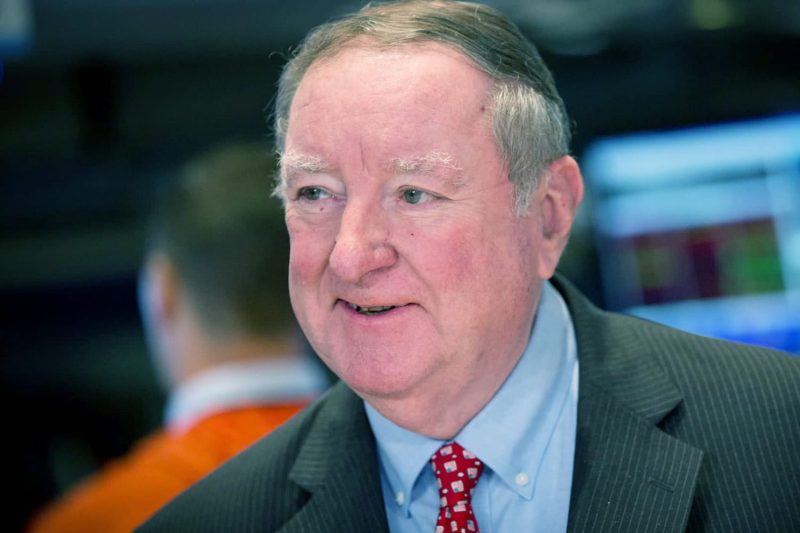
Art Cashin, UBSâ€

In the intensely competitive and often vicious world of stock market commentary, Cashin was that rarest of creatures: a man respected by all, bulls and bears, liberals and conservatives alike. He seemed to have almost no enemies.
He was a great drinker and raconteur, a teller of stories.
For decades, he assembled a group of like-minded friends every day after trading halted, first at the bar at the NYSE luncheon club, then across the street at Bobby Vanâ€
Cashinâ€
Cashin refused to use credit cards and paid for everything, particularly his voluminous bar bills, with cash, saying he cherished his anonymity. He never learned to use a computer–his notes were hand-written and then sent to his assistant. For years, he used an obsolete flip phone that he rarely answered.
His desk was piled high with papers he had accumulated over the decades. At times, it resembled a recycling facility.
Cashinâ€
However, neither his appearance nor his attitude was haphazard. It was part of a persona that was carefully constructed over more than 50 years on Wall Street.
Arthur D. Cashin Jr. was born in Jersey City, New Jersey, in 1941. His parents were superintendents of an apartment building. His business career began in 1959 at Thomson McKinnon, a brokerage firm, when he was 17 and still in high school. Cashin had been obliged to join the workforce when his father died unexpectedly that year.
In 1964, at age 23, he became a member of the NYSE and a partner of P.R. Herzig & Co.
At that time, the vast majority of all trading took place on the NYSE floor. Cashinâ€
In the mid-1970s, disgusted by the corruption in his hometown of Jersey City, Cashin ran for mayor. “I think I ran 12th in a field of five,â€� he said. “But once they discovered I was honest, there wasnâ€
He returned to Wall Street. In 1980, he joined PaineWebber and managed its floor operation, continuing to do so after PaineWebber was bought by UBS in 2000.
Then came 2001.
Cashin would often recall what it was like to escape from Ground Zero on Sept. 11, 2001, after terrorists crashed two jetliners into the World Trade Center towers, killing more than 2,600 people in the heart of the nationâ€
“Many of us got out that Tuesday walking through streets onto which ash, smoke and business envelopes fell snow-like, blocking both your view and your breathing,â€� he wrote in a commentary 13 days later. “Yet when a stranger was met, they were invited to join the convoy and offered a spare wet cloth (carried in pockets) through which to breathe as they walked. When we reached the East River (Brooklyn side of Manhattan), there was a volunteer group of tugboats, fishing boats and mini-ferries that looked like the evacuation of Dunkirk. No charge. No money. Just — “May I help you!â€� No one got anyoneâ€
After the Sept. 11 attacks, Cashin chaired the NYSE “Fallen Heroes Fund,� which provided millions of dollars to the families of first responders killed in the line of duty.
Though he was a respected market historian, he was most renowned as a storyteller for the stock market. He was a meticulous observer of fundamental and technical trading patterns but never let data get in the way of explaining the market in a folksy manner that made it accessible to even casual observers. He often spoke of Wall Street as a community of people with many different opinions. In his world, the bulls and bears would fight it out every day, as if it were all a John Wayne Western: “The bulls are circling the wagons, trying to defend the highs� was a common refrain.
His daily market commentary, Cashinâ€
He was a keen observer of human behavior, a behavioral psychologist long before the word was coined. He had seen his fellow humans panic time after time, and had seen the effects of succumbing to the initial desire to sell immediately without thinking. “It tells me that people have a tendency to overreact — and to not think things through carefully,â€� he said. “And you break up, again, into two sets of people, those who look with some suspicion at events, and others who say, ‘Oh, Iâ€
He had two great loves in his life: his family and the New York Stock Exchange. In the age of computerized trading, the fabled NYSE trading floor still survives, though in greatly diminished form. When it was closed during the Covid pandemic, he said he was “disappointed … but it was understandable.â€�
Cashin was philosophical when asked about the rise of electronic trading, which has slowly but surely eroded the influence of that floor. “I miss those magnificent days when your spirit hung on the fact that you were good for your word or youâ€
Among his many friends, he will perhaps be best remembered for his modesty. He seemed genuinely puzzled about his popularity. “People have an interest in — in Arthur Cashin. I canâ€
And when The Washington Post ran a long profile of his career in 2019, calling him Wall Streetâ€
In lieu of flowers, the family kindly requests donations be made to the Arthur D. Cashin Jr. Memorial Scholarship at Xavier High School. Contributions may be sent to Xavier High School, 30 West 16th Street, New York, NY 10011.
— CNBCâ€