
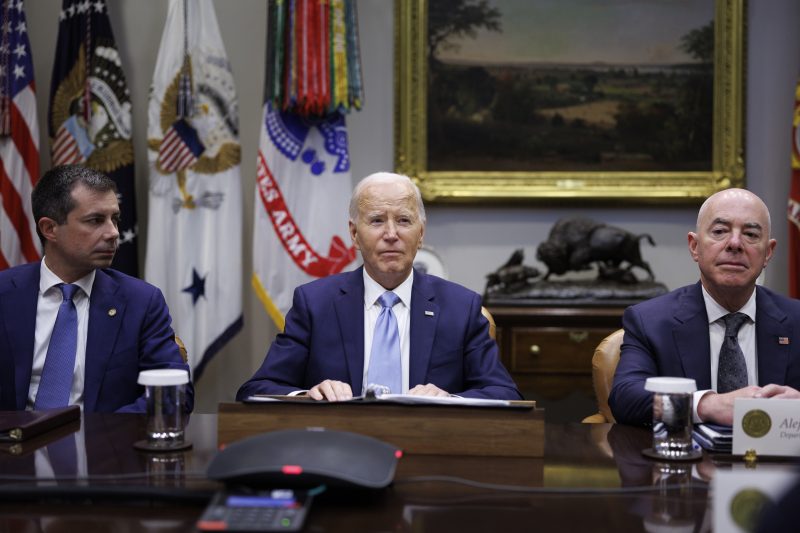
The White House is working to limit the Israeli response to the barrage of ballistic missiles that Iran fired into the country Tuesday, as some U.S. officials worry the Middle East could be edging closer to the all-out war that President Joe Biden has sought to prevent for nearly a year.
Several senior Biden officials, speaking on the condition of anonymity to discuss sensitive conversations, said Wednesday that Israeli officials have told them privately that they do not feel the need to hit back against Iran in an immediate and massive way. Yet officials in the United States and Europe fear that Israel could hit economic targets in Iran that would prompt a dangerous escalatory reaction.
Tehran has long signaled that attacks on its oil and gas industry would be a “red line,� a senior European official said. Such a strike would probably prompt retaliatory attacks from Iran on Western energy interests, potentially disrupting the global economy one month before the U.S. presidential election.
American officials say they are encouraging Israel to respond in a measured way, but U.S. allies in Europe are concerned that Washington is not putting sufficient pressure on the government of Prime Minister Benjamin Netanyahu. “Our understanding is the Americans are not holding them back,� said the official, who spoke on the condition of anonymity to discuss a sensitive military matter.
Biden administration officials say that while Israeli leaders have suggested they will act with restraint, that could change once Netanyahuâ€

At the same time, Israeli leaders have taken a relatively aggressive tone toward Iran publicly.
Inside Israel, there is a strong appetite for a major military response, with a sense that Iran is unusually weakened because its strongest proxy, Hezbollah, is reeling from recent Israeli attacks that damaged its communication system and decimated its leadership. Former Israeli Prime Minister Naftali Bennett recently urged Netanyahu to immediately authorize strikes on Iranâ€
“We must act *now* to destroy Iranâ€
On Wednesday, Biden said he did not support an Israeli strike on nuclear sites in response to a question. A senior administration official said Israeli officials have not discussed such a move in private conversations with U.S. officials.
Last week, U.S. officials believed they had Israeli sign-off on a cease-fire proposal with Hezbollah, officials said at the time, only for Netanyahu to forcefully reject the proposal once the United States and other countries, including France, announced it publicly.
“What the Americans understand is the Iranians desperately donâ€
Iran fired about 180 missiles directly into Israel on Tuesday with little advance warning — only the second time the country has launched a direct attack into Israeli territory — in retaliation for Israel killing Hezbollah leader Hasan Nasrallah last week in Beirut. That strike also killed an Iranian general, and Iran had yet to retaliate for Israel killing Hamas chief Ismail Haniyeh in Tehran in July.
The Israeli military announced Monday the start of ground operations in southern Lebanon, where Hezbollah militants had been launching drones and rockets into Israel since Hamas carried out a surprise attack on Israel last Oct. 7 that killed some 1,200 people.
Iran had launched missiles into Israel in April, and this time, Tehran sought to muster a more effective air assault, according to analysts, relying mostly on ballistic missiles and abandoning slower weapons such as drones and cruise missiles. That provided less advance warning for Israelâ€
Still, while the latest attackâ€
The success of the United States and Israel in repelling Iranian missiles for a second time has boosted confidence inside Israel, a senior administration official said, and in private conversations Israeli officials have signaled that they will respond in a calibrated way. That is a stark change from April, the official noted, when the United States publicly and privately had to urge Israel to respond with restraint to avoid a further escalation.
A senior administration official said the United States and Israel, along with other international partners, crafted a defense plan to help defend against potential Iranian attacks that “worked as well as we could have wanted it to work.â€� The fact that no Israelis were killed and that the countries were able to thwart all of Iranâ€
But the Middle East is even more combustible than it was just a few months ago. Israel in recent weeks has launched intelligence and military actions against Hezbollah in Lebanon, pounding the country with airstrikes that have killed more than 1,400 people and displaced nearly 1 million. And Israel did not inform the United States ahead of time of several major actions in Lebanon, including one that detonated pagers and handheld radios used by Hezbollah and another that killed Nasrallah.
While U.S. officials have said they are impressed by Israelâ€
Senior Biden aides are particularly concerned that Israelâ€
Since Hamasâ€
U.S. officials for months have been trying to get Israel and Hamas to agree to a cease-fire, but those efforts are deadlocked as neither side appears willing to make enough concessions to cement a deal. The United States is also pressing for Israel and Hezbollah to agree to a cease-fire and come to a diplomatic solution that would resolve the conflict on the Israel-Lebanon border.
But Biden has been unwilling to use the most significant source of U.S. leverage — conditioning or suspending military aid to Israel — to try to change the dynamics of the war, as Israel has repeatedly rebuffed U.S. advice and counsel.
Between the United States and Israel, there are “major efforts on both sides to keep lines of communication open and make sure that perspectives are understood. There have been moments of surprise, I donâ€
“As important as a response of some kind should be, there is a recognition that the region is really balancing on a knifeâ€
Ellen Nakashima contributed to this report.