

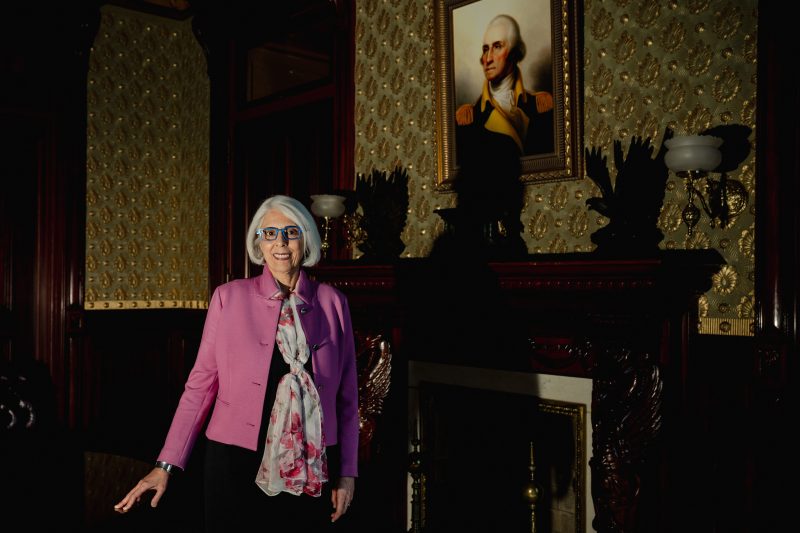
Early in her career, Arati Prabhakar led the development of a self-piloting ship for a secretive U.S. military research agency. Now sheâ€
For three decades, the United States threw itself headlong into globalization, backed by the confidence that while a rising tide lifts all boats, Americaâ€
“We had an oversimplified model for a long time, for a number of decades,� Prabhakar said in an interview with The Washington Post. “That oversimplified model was that markets and globalization would solve all the problems.�
Prabhakarâ€
“Itâ€
Kevin Wolf, a former assistant commerce secretary for export administration, says the Biden administration has enacted the strictest technology export controls against China in recent memory, adopting the policy position that China having the capability to produce advanced computing systems indigenously is a “per se national security threat� to the United States.
The hard-line shift is reflected in the appointment of Prabhakar, 65, as the presidentâ€
In contrast, Prabhakar previously oversaw the Pentagonâ€
Many of these projects will take far longer than a four-year presidential term to accomplish, a recognition that the technological rivalry with China may last decades, as the Cold War did.
Her team is already maneuvering to wrangle commitments from allied nations to support U.S. wireless technologies over Chinaâ€
“It is the right time to start lining everyone up,� Prabhakar said about building a 6G coalition around the U.S. position.
Her office sits in the Eisenhower Executive Office Building on the White House grounds, down a hallway checkered black-and-white like a chess board. The Bruce Springsteen lyric “Meet me in a land of hope and dreams� is emblazoned across the wall.
After immigrating to the United States from India with her parents as a child, Prabhakar earned a PhD in applied physics from Caltech, then strayed from the academic career path. She was working at DARPA in 1986 at the tail end of the Cold War.
“The Soviet Union ended while I was at DARPA, and so I saw what an enormous shift started in how we thought about national security,� she said.
Following the Soviet Unionâ€
“We were riding high,� said Rob Atkinson, founder of the Information Technology and Innovation Foundation. “We were the center of the internet and the IT economy. China was nothing. … We assumed that would continue in perpetuity.�
Chinaâ€
National security adviser Jake Sullivan announced in September 2022 that the United States could no longer just maintain a “relative� technological lead over rivals and “must maintain as large of a lead as possible.� Soon after, the Commerce Department, led by Gina Raimondo, fired a fusillade of technology export controls at China.
Prabhakarâ€
The Biden administration also has leaned hard into industrial policy in key technological sectors like chips and telecommunications gear, with the help of $52 billion in funding from the bipartisan Chips and Science Act.
Ken Zita, a telecom expert who advised the Biden administration on industrial policies, said Washington was making the leap from “no industrial policy� to “having one� after many years in which industrial planning by the federal government was deeply out of fashion.
“Theyâ€
A major challenge for the Biden administration has been how to pursue this policy shift without fanning anti-Chinese sentiment.
Prabhakarâ€
Prabhakar said her team is now “pretty close� to a final version of the rules, though she stopped short of saying when they may be released. She said that after they released a draft version of the rules for comment last year, feedback from the research community gave her pause, including input that the requirements for universities were too onerous.
“Itâ€
“Doing this in a way that respects every individual, their rights as an individual and respecting their dignity, I think, is critically important,� she said. “Not exacerbating anti-Asian bias in the environment that we are in — absolutely key.�
The draft guidelines issued by her office for comment calls for research institutesâ€
More broadly, the Biden administrationâ€
“When I do travel — and by overseas l mean Taiwan, Japan, Korea, Switzerland, Germany, the Netherlands, U.K., you know, allied countries — almost to a person, they donâ€
Some, such as Atkinson, say the grants for building new U.S. technological hubs have been distributed too diffusely.
“The whole point of this was you canâ€
Prabhakar defended these measures as part of a carefully considered long-term plan to ensure U.S. competitiveness.
“Itâ€