
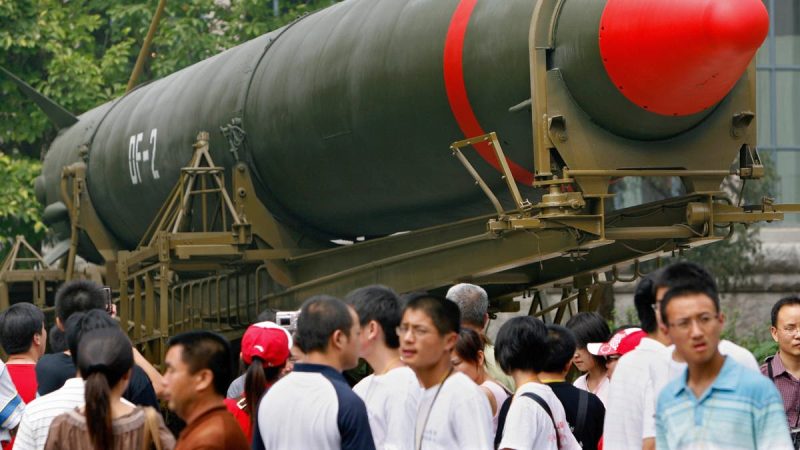
China is expected to double its nuclear arsenal to 1,000 warheads over the next five years, according to a new Defense Intelligence Agency (DIA) report.
In 2020, the DIA assessed China had acquired 200 nuclear warheads and would double that by the end of the decade. Now, the intelligence agency says China has already reached 500 warheads and will have more than 1,000 by 2030.
‘China is undergoing the most rapid expansion and ambitious modernization of its nuclear forces in history,’ the report said, while noting Chinaâ€

At the same time, China carried out another ‘combat control’ near the island over the weekend as Beijing threatens countermeasures for the U.S.â€
That deal included, for the first time, an advanced air defense system battle-tested in Ukraine.
Taiwan’s defense ministry said it had detected 19 Chinese military aircraft, including Su-30 fighter jets, carrying out a ‘joint combat readiness patrol’ around Taiwan in conjunction with Chinese warships starting on Sunday morning.
The report confirmed findings in the Pentagon’s 2023 report on Chinese military power.
Russia has about 1,550 deployed strategic warheads and 2,000 non-strategic warheads, according to the report.
Behind China are France, the United Kingdom, Pakistan, India, Israel and North Korea.
‘Compared to the PLAâ€
Beijing has long upheld a non-first-use (NFU) policy and called for talks among other nuclear powers about a joint commitment to do the same.
But, the new report warns: ‘Chinese nuclear thinkers could be reconsidering their long-standing view that nuclear war is uncontrollable.’
The agency predicted China could resort to nuclear weapons if a war over Taiwan, which Beijing views as its territory, posed an existential threat to the CCP.
China may accept ‘greater risk’ as its capabilities mature, according to the report. The nation is also pursuing low-yield nuclear warheads to be used for ‘proportional’ responses to conflict.
‘Coupled with PLA officers downplaying the risks of imperfect information management during crises, inexperience managing nuclear crises, and their perceptions that they can elicit intended adversary responses while maintaining sufficient battlefield awareness, Beijing may accept greater risks as its nuclear doctrine and capabilities mature.’
The Pentagon has lately been grappling with how to prepare for 2027 – the point at which Chinese leaders have told their military they should have the capability to invade Taiwan.
As Iran continues to enrich uranium at rapidly expanding rates and surveillance finds new activity at nuclear sites, Tehran ‘almost certainly’ does not yet have nuclear weapons capability, according to the report.
North Korea, meanwhile, is now fighting on behalf of Russia in Ukraine – prompting global concerns that Moscow could be providing support for Pyongyang’s nuclear programs.