

Democratic strategists beat back potentially catastrophic third-party threats this year with a campaign to force attorney Robert F. Kennedy Jr. from the race and prevent a presidential bid by the moderate group No Labels.
But advisers to Vice President Kamala Harris still say the final outcome in key swing states could hinge on the remaining independent and third-party contenders, who are collectively drawing about 5 percent of the vote in public polls.
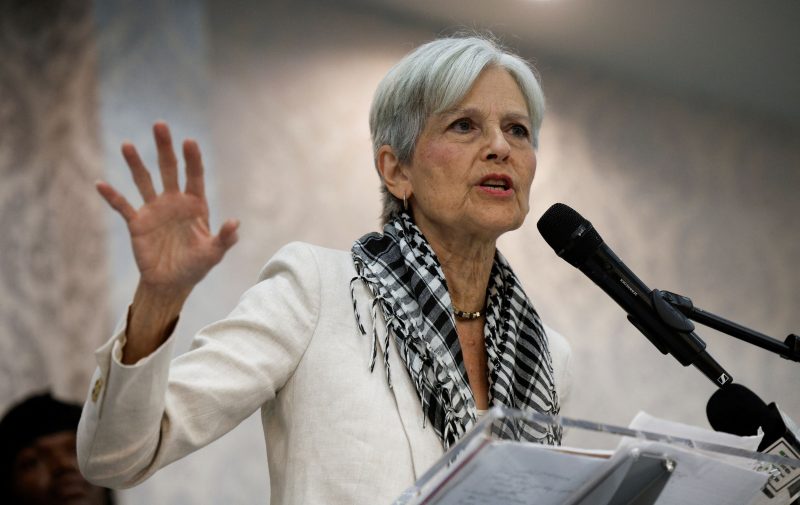
In response, the Democratic National Committee on Friday launched its first television ad targeting the candidacy of Jill Stein, the perennial Green Party candidate who has been registering at about 1 percent of the vote in the northern swing states.
The ad will run on televisions in Wisconsin, Michigan and Pennsylvania, along with national broadcasts on cable news. The DNC did not announce how much money would be put behind the spot.
Over an image of Stein that morphs into an image of Republican nominee and former president Donald Trump, the ad describes Steinâ€
“Jill Stein, I like her very much,� Trump said at a June rally in Philadelphia. “You know why? She takes 100 percent from them.�
“Just like in 2016, Jill Stein canâ€
The ads come as Stein has described keeping Harris from the White House as one of the goals of her campaign. On Wednesday, she accepted the endorsement in Michigan of Abandon Harris, a Muslim American group organized to oppose U.S. support of Israelâ€
Before she spoke, one of the groupâ€
Stein, in her remarks at the event, said she still hoped to win the White House. But she also defined victory for her campaign in much more modest terms, saying her campaign can also win by denying either of the major party candidates, Trump or Harris, victory because of their support for Israelâ€
She continues to campaign on other liberal issues, including efforts to reverse climate change, fight income inequality and improve access to ballot box for minor-party candidates.
“The Kamala Harris campaign is looking for a scapegoat,â€� Stein said Thursday in an interview, about the Harris campaignâ€
Stein is one of three independent candidates who have been registering at least 1 percent in recent public polls, along with the left-leaning scholar Cornel West, who is running on a “truth, justice and love� platform, and libertarian candidate Chase Oliver.
In a razor-thin major party result, any third-party votes could prove decisive. But pollsters say it is more complicated to divine whether voters for third-party candidates are directly pulling votes away from either major party candidate. Democratic strategists say they do not believe all of the supporters of Stein or West are available as potential Harris voters, just as not all supporters of Oliver are potential Trump voters. Many voters are motivated primarily by their opposition to both major parties.
Clear Choice, a super PAC founded to help minimize the harm third-party and independent candidates do to Democrats, calculated through polling at the start of the year that Democrats were losing two to three percentage points in support because of the minor candidates in the race. They now calculate the damage is less than a percentage point.
“The third-party penalty for Democrats that existed for almost the entire cycle has been pretty deflated at this point,� said Pete Kavanaugh, the founder of Clear Choice. “Oliver is generally becoming as big a problem for Trump as Stein and West are for Harris.�
In late 2023, hypothetical political polls of the presidential contest that included Trump, Biden, Kennedy, West and Stein repeatedly showed that third-party and independent candidates were drawing as many as 1 in 5 voters nationally. But those numbers began to fall after the end of the Republican primaries, as voters focused more on the choice before them.
In a Washington Post average of June polls ending before the Biden-Trump debate, Trump had 41 percent support, Biden had 40 percent support, Kennedy had 7 percent, West 1 percent, Stein 1 percent and Oliver 1 percent. The third-party total was 10 percent. An average of 7 percent were not sure or undecided, 1 percent said “other� and 3 percent said they would not vote.
In a Post average since the Sept. 10 Harris-Trump debate, Trump had 46 percent support, Harris had 48 percent support, Kennedy had 2 percent, West 1 percent, Stein 1 percent and Oliver 1 percent. The third-party total was 5 percent. An average of 3 percent were not sure or undecided, 1 percent said “other,� and 1 percent would not vote.
Kennedy endorsed Trump in August, but he remains an option on the ballot in Wisconsin and Michigan. West is on the ballot in Michigan, North Carolina and Wisconsin, while still fighting for ballot access in Pennsylvania. West will also appear on the ballot in Georgia, but the Supreme Court in that state has ruled votes for him will not be counted in the election.
Edwin DeJesus, a co-campaign manager for West, said West supporters should vote for him anyway in Georgia and write in Westâ€
Stein will appear on six of the seven major swing states being contested by Trump and Harris, with Nevada being the exception. Oliver will appear on all seven.
The Abandon Harris coalition is just one part of the Muslim American communityâ€
The groupâ€
Emily Guskin contributed to this report.