

ANN ARBOR, Mich. — Wearing a navy blue Harris-Walz jacket and a camo baseball cap, Minnesota Gov. Tim Walz sat in a private suite in Michigan Stadium on Saturday, cheering on a football game with 110,339 other fans and giving the campaign a high visibility perch on a busy September weekend.
Eight hours later and more than 750 miles away in Tuscaloosa, Ala., GOP presidential nominee Donald Trump settled into his own seat in Bryant-Denny Stadium for the much-anticipated showdown between No. 2 Georgia and No. 4 Alabama. Alabama is reliably red territory on the political map, but the appearance provided Trump an opportunity to nudge his way into the nightâ€
The presidential campaign season overlaps with the football season, but rarely have the two been so closely intertwined, as both campaigns have used the countryâ€
Perhaps Walzâ€
But over the past decade, many in Walzâ€
This year, Walz — a former high school football coach and educator — has struck a different tone, telling crowds at rallies and fundraisers that although Vice President Kamala Harris “took back� freedom, the American flag and family values from Republicans, he was the one to take back football.
“I will admit to this: It was me who took the football back,� he said at one recent fundraiser in McLean, Va.
Though Trump has dinged Walz for being an assistant — not the head coach — at Mankato West High School in Minnesota, Democrats have treated Walzâ€
Deploying the pigskin playbook makes political sense. Around two-thirds of Democrats and nearly three-quarters of Republicans and independents are football fans, according to a 2023 Washington Post-University of Maryland poll. Politicians have varying levels of comfort shedding their suits and ties on fall weekends, but attending football games offers an opportunity for candidates to reach large numbers of voters while projecting relatability.
Professional football is an all-but unstoppable cultural force in America: 93 of the top 100 television broadcasts last year were National Football League games, according to Nielsen. And college football, which attracts smaller audiences than the NFL but still draws millions of fans each week, is expected to grow: ESPN recently agreed to pay $1.3 billion per year to broadcast college footballâ€
“Football is the most popular sport in America, and by showing that they love and care about the sport, candidates can try to make a personal connection with ordinary voters and to show them that they are just like them,� said Costas Panagopoulos, a professor of political science at Northeastern University. “Making these kinds of personal connections is incredibly powerful on the campaign trail.�
Walz and his family were planning to attend the Michigan-Minnesota matchup even before he was selected as Harrisâ€
Democrats have used football games as an opportunity to reach voters in other ways, too. The Harris-Walz campaign and its allies have advertised heavily during game broadcasts and flown banners pulled by small airplanes over college stadiums located in key swing states: “JD Vance ‘heartsâ€
On Saturday, at a pair of college games in North Carolina, the party paid for electronic billboards to parade through pregame tailgate parties, highlighting Trumpâ€
“Democrats are leaving it all on the field in the race to November, and that means reaching voters through nontraditional methods,â€� Abhi Rahman, the Democratic National Committeeâ€
In the weeks ahead, the Harris-Walz campaign plans to ramp up its presence in the sports world with TV buys during some of the yearâ€
On Saturday, it launched Athletes for Harris, an effort to mobilize coaches and athletes, noting in the announcement that “athletes are among the most trusted voices for key voting blocs, especially young men� and that “sporting events and games are also key moments that draw in large and politically diverse audiences, audiences that are increasing their reach with Gen Z and younger men.� The group includes 15 Pro Football Hall of Famers — Emmitt Smith, Drew Pearson and Calvin Johnson among them — who endorsed Harris-Walz.
Even in states and communities with sharp political divisions, football can be a great unifier, like it is for Dawn Nettlow, 57, and Betsy Andreu, 57, former college roommates at the University of Michigan who now live in Dearborn, Mich., and attended the game together on Saturday.
Nettlow is backing Harris, Andreu is not.
“I hope what happens at the game today will happen on November 5 to Tim Walz,� said Andreu, clad in Michigan gear, correctly predicting a Minnesota loss.
Nettlow, however, said she was excited to learn Walz was at the game — and that she was unaware he was a former high school coach himself.
Football has often been a domain occupied by Republican candidates, and college football especially is popular in red-leaning states throughout the Deep South and rural Midwest. So itâ€
Although Al Gore and President Joe Biden both played football in high school (and Biden continued his freshman year at the University of Delaware), the Democrats have typically run candidates more closely associated with other sports. John F. Kerry was a cyclist, among other athletic pursuits, President Barack Obama played basketball, Bill Clinton golfed, and Michael Dukakis and Jimmy Carter were both runners.
Trumpâ€
Trump has used football to ignite his base, and the sport became a flash point in the culture wars during the 2016 presidential race. Trump and Republican leaders called out NFL players, such as Colin Kaepernick, who took a knee during the national anthem, protesting police violence and racial inequity. He has repeatedly challenged NFL brass and team owners, saying professional football “has become softâ€� and “boring as hell,â€� and has been critical of rules designed to make the game safer, recently calling the NFLâ€
The NFL plays its games in the countryâ€
Trump could reasonably expect a friendly crowd in Tuscaloosa on Saturday — he won the state by more than 25 points in 2020 — but Democrats still hoped to elbow their way into the spotlight.
The Harris campaign unveiled a new TV ad ahead of Trumpâ€
The football day had begun very early in Tuscaloosa Saturday, with ESPNâ€
The masses of tailgates included one from Alabamaâ€
Trump has at times wanted to attend fraternity tailgates or outdoor events before football games, but his team has usually scuttled that idea.
Trumpâ€
At the game, the Secret Service boosted its protection around Trump to levels that one aide, speaking on the condition of anonymity to discuss security arrangements, said they had never seen before.
By the time the former president appeared on the giant video screens at Bryant-Denny Stadium on Saturday evening, Alabama had surged to a brisk and breathtaking 28-0 early lead over Georgia, sending the home fans into a joyous frenzy.
The bedlam continued when Trump, introduced on the public address as “the 45th president of the United States,� received strong, steady cheers as he waved from behind a window inside a suite. Chants followed: “USA! USA!�
Trump has enjoyed going to football games at SEC stadiums where the crowds love him, but he usually leaves long before the game is over. During his presidency, for example, he left the national championship in Atlanta during the beginning of the third quarter. He follows the NFL more closely than college football, a person who has talked sports with him said, speaking on the condition of anonymity to detail a private conversation.
Trump “isnâ€
If Trump occasionally finds the college game less than compelling, heâ€
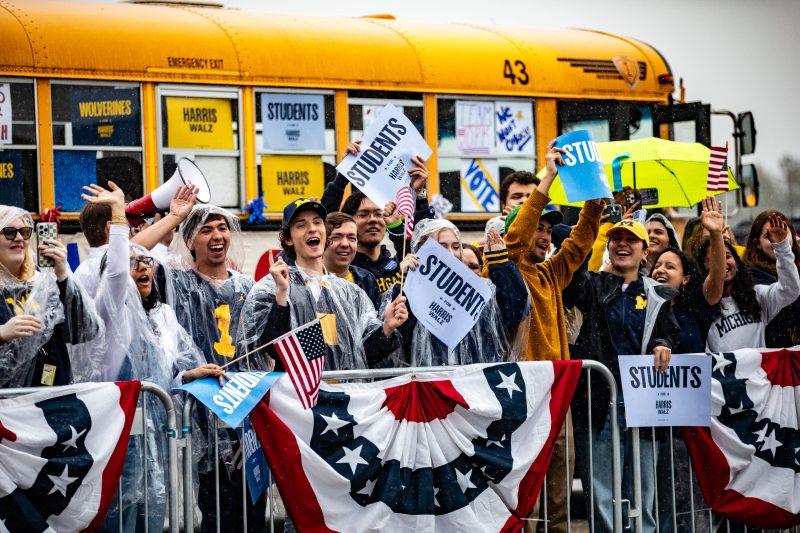
Before wandering in to the Michigan-Minnesota game Saturday, Walz stopped by a rainy tailgate, where supporters sought shelter — and selfies — under a branded Harris-Walz tent.
He grinned as he said yes to every selfie request, then paused to ask two children how they thought the game would go before answering his own question.
“Michiganâ€
The kids stared blankly back at the governor. Even at a Big Ten tailgate, not everyoneâ€
Culpepper reported from Tuscaloosa. Wells reported from Ann Arbor.