
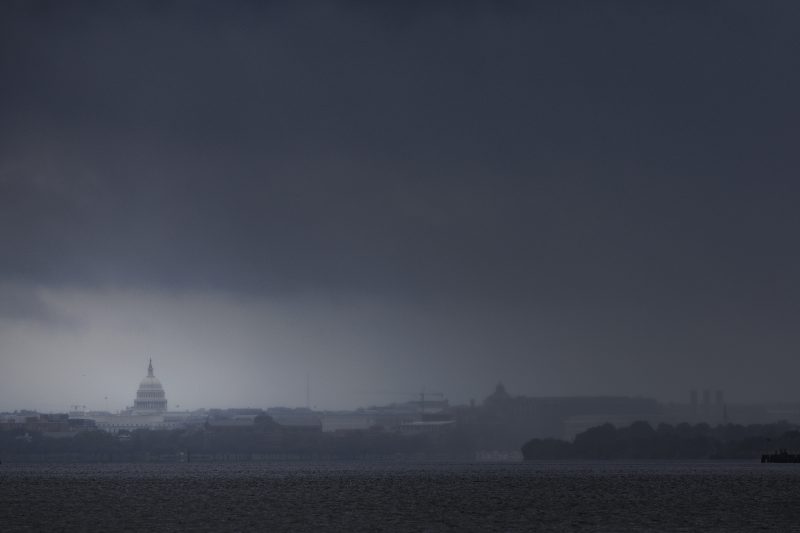
No matter who wins the White House, the next president is increasingly likely to face an unusual hurdle in their first days in office: a divided Congress.
Each of the last five newly elected presidents has entered office with his party holding the majority in the House and Senate, opening the door to an aggressive agenda. But now, Democrats need a net gain of just four seats to reclaim the House majority, while Republicans need just one more flip, with two big opportunities in conservative states, to win back the Senate.
Such a split verdict would be historic: The House and Senate have never both switched majorities in opposite directions in any election since the direct election of senators began 110 years ago. It would also guarantee that Kamala Harris or Donald Trump would enter the Oval Office on Jan. 20 without his or her party in full control of Congress.
From Bill Clinton in 1993 to Joe Biden in 2021, the most recent presidents took office with their party fully in charge on Capitol Hill and began to advance their most important agenda items.
Influential Capitol Hill veterans from that era said the winner in November could be immediately reined in by an opposing party holding the House or Senate, given this politically combustible time when bipartisan dealmaking has been limited to modest measures or must-pass legislation.
“A split Congress at this point means a legislative dead-end for major policy initiatives legislatively and would likely further enhance the subordination of the legislative to the executive branch, which will govern through executive actions,â€� said John Lawrence, who served as chief of staff in 2009 and 2010 for House Speaker Nancy Pelosi (D-Calif.) during a productive early part of Barack Obamaâ€

“Bipartisan lawmaking is possible, but itâ€
In 1989, George H.W. Bush was the last president to enter office without his party in control of both chambers. The Democratic majorities in both the House and Senate limited Bushâ€
Instead, he largely focused on foreign policy matters, and lost his reelection bid in 1992.
Trumpâ€
But priorities such as extending many of the rates set in his 2017 tax law, as well as new cuts for corporations and the wealthy, would be curtailed by a House Democratic majority and a speakership held by Hakeem Jeffries (D-N.Y.), who is currently House minority leader.
Likewise, Harrisâ€
Those would be very difficult to get approved if sheâ€
This dynamic creates the potential for a continuation of the gridlock of the past two years in Washington, when President Joe Biden spent so much time struggling with the House GOP majority over fiscal matters. Next year requires another congressional hike of the nationâ€
“In short, next year a new president will struggle to move a big agenda in a divided Congress and will have to devote much of the year to dealing with tax and spending issues,� said Antonia Ferrier, who served in 2017 and 2018 directing a strategic communications office for McConnell.
David Krone, who served as a senior adviser to Senate Majority Leader Harry M. Reid (D-Nev.) in 2009 and 2010, recalled how his boss and Pelosi, the House speaker, used their large majorities to ride herd on their committee chairs to produce a massive economic stimulus package, the Affordable Care Act and the Dodd-Frank law rewriting oversight of Wall Street. Those served as some of Barack Obamaâ€
“Now, itâ€
These prognostications could all be for naught if one party pulls off the political trifecta of winning the White House along with the House and Senate majorities. That would most likely require Harris or Trump winning convincingly enough to have coattails that would help down-ballot candidates win in very unfavorable regions.
The presidential race remains a toss-up. Harrisâ€
In the House, Harrisâ€
Of the 13 toss-up races Republicans are defending, as rated by the Cook Political Report With Amy Walter, 10 are in four states where Biden won by more than 15 percentage points four years ago. Harris will probably match or exceed that margin in November.
Democrats could win enough seats just in those friendly states to claim the House majority. In the Senate, however, Republicans have the much better political terrain, already holding 49 seats and the Democrats all but conceding West Virginia to them with the retirement of Sen. Joe Manchin III (I).
Barring a major upset of either Sens. Ted Cruz (R-Tex.) or Rick Scott (R-Fla.), Democrats need Harris to win and defend every remaining seat of theirs, including those of Sens. Jon Tester (Mont.) and Sherrod Brown (Ohio), states where Trump might win by double-digit margins.
Facing a GOP Senate could cause immediate headaches for a Harris administration. Biden managed to efficiently get every single Cabinet secretary confirmed by the spring of 2021, as well as Supreme Court Justice Ketanji Brown Jackson a year later, with the narrowest of Senate majorities.
Harris would have the luxury of asking some secretaries and deputies to remain in their posts, but history suggests many would prefer to move on.
Lawrence recalled how different times were in 2001, when George W. Bush became president with similarly narrow majorities for Republicans. He won a sizable bloc of Democrats for his 2001 tax cuts and a majority for his No Child Left Behind Act.
By the time that education bill got signed into law, Democrats had taken over the Senate majority because of a party switch, but it did not matter. Bush had won the support of Sen. Edward M. Kennedy (D-Mass.) and Rep. George Miller (Calif.), the top Democrats on education policy.
In 2009, Obama briefly had a 60-seat majority in the Senate and a bulging House majority with more than 255 Democrats. Fearing political extinction, Republicans decided to almost unanimously oppose every big presidential agenda item.
That required legislative tacticians to maneuver some measures to pass on a fast-track process. “Senator Reid had the ability to shape what he wanted. Same with Speaker Pelosi,� Krone recalled.
Likewise, Republicans had some successes and some failures in 2017, when they tried a similar go-it-alone approach. They failed miserably in their attempt to repeal the ACA despite seven years of promising to do so, but they succeeded in ramming through a nearly $2 trillion tax cut plan without a single Democratic vote.
“Both parties have just used brute political force when they had the opportunity,� Buck said.
Biden and Democrats used brute force to pass a nearly $2 trillion pandemic rescue package in 2021 and a massive climate and prescription drug law in 2022. They also scored some bipartisan success on projects ramping up infrastructure spending and rebuilding chip manufacturing. Those deals, however, would have looked less desirable for Democrats if they were in the minority and Republicans were leading negotiations.
Now, as Harris and Trump look ahead to the possibility of taking office on Jan. 20, both might have to reconsider their expectations for early success.
“In the first 100 days, when a new president wants to put points on the board to show that they can deliver, that might not be the reality,� Ferrier said.