

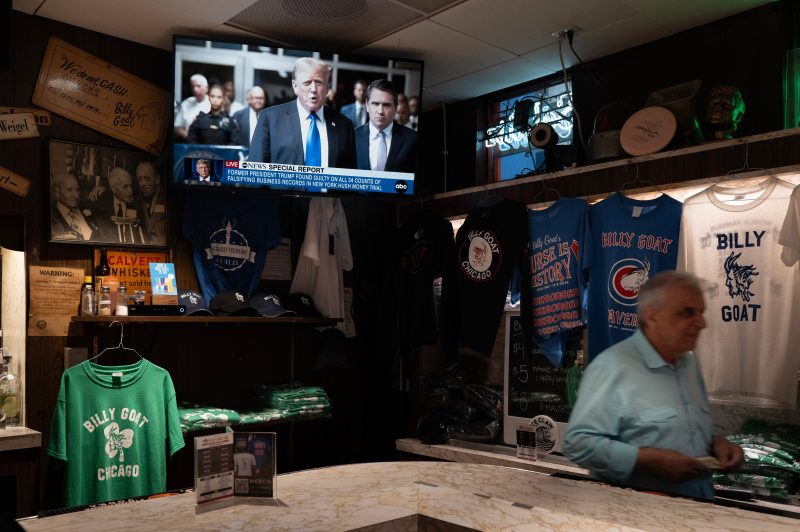
Thousands of Florida residents lose their right to vote every year when they are convicted of a felony. But by a quirk of the law, Florida resident Donald Trump likely will be able to cast a ballot in November despite his convictions this week.
If the former president had been convicted in Republican-dominated Florida or most other states, he would not be allowed to vote this fall as he seeks to unseat President Biden. But Trump was convicted in New York, a Democrat-run state where felon voting laws are more lenient, and that makes all the difference for his ability to keep his right to vote.
Under Florida law, residents convicted of crimes in other states lose their ability to vote in Florida only if they are barred from voting in the state where they committed their offenses, according to the U.S. Vote Foundation. In New York, where Trump was convicted, felons are barred from voting only while they are incarcerated, according to the foundation and Loyola Law School professor Justin Levitt.
The New York jury on Thursday convicted Trump of 34 felonies for falsifying business records over hush money payments he made to cover up an alleged affair with adult-film actress Stormy Daniels.
He will be sentenced on July 11, days before Republicans are slated to nominate him for president at their convention in Milwaukee. Legal experts have said Trump, as a first-time offender, is unlikely to be sent to prison. Even if he receives a prison sentence, Trump may be able to use appeals to avoid incarceration until after the election.
And because heâ€
Trump faces felony charges in three other cases but it is not clear that any of those will go to trial before the election. In a state case in Georgia and a federal case in Washington, D.C., Trump is charged with crimes related to attempting to overturn the 2020 election. In a federal case in Florida, he is charged with mishandling classified documents.
Trump for years has falsely claimed the 2020 election was rigged, and his lies about the results culminated in the assault on the U.S. Capitol as Congress certified Bidenâ€
At one point he suggested thousands of felons who were ineligible to vote had cast ballots in Georgia. At another, he criticized Vice President Mike Pence for listening to “stupid people� about certifying the results. Then he added, “It is also widely understood that the voter rolls are crammed full of noncitizens, felons and people who have moved out of state, and individuals who are otherwise ineligible to vote.� (Numerous reviews by election officials and courts found the 2020 election was correctly called for Biden.)
In 2021, New Yorkâ€
New Yorkâ€
For years, felons in Florida were banned from voting for life unless the stateâ€
Voters in a 2018 ballot measure amended the state constitution to give most felons the right to vote once they completed their sentences. Gov. Ron DeSantis and his fellow Republicans in the legislature promptly blunted the measure by approving a law that said felons could not reclaim their right to vote until they paid fines related to their crimes. That put the ability to vote out of reach for many who had completed their terms of prison and probation, but still had outstanding debts.
In 2022, DeSantis formed a police unit focused on election crime, and its first arrests focused on felons who he said had illegally voted. Many of those cases have fallen apart.
Desmond Meade, the executive director of the Florida Rights Restoration Coalition and a leader of the effort to restore felonsâ€
“Being willing to vote for somebody who just was convicted of a felony offense for the highest office in the land removes any excuse that you may have had in the past about preventing someone with a felony conviction from just voting,� he said in an interview.
Maya Wiley, president of the Leadership Conference on Civil and Human Rights, said she supported laws like New Yorkâ€
“I would say Donald Trump should be able to vote, but thatâ€
If Trump were incarcerated during the election and barred from voting under New Yorkâ€
Laws differ significantly from state to state, and Trumpâ€
“Despite the fact that the vast majority of people with felony convictions do have the right to vote, many believe that they canâ€
Voting policies for felons vary widely from state to state, according to the Brennan Center. Some allow felons to vote as soon as they are released from prison and some when they complete their sentences of probation or parole. On the other end of the spectrum, some states permanently bar some felons from voting unless they get special dispensation from the government.
About 4.4 million were barred from voting in 2022 because of a felony conviction, according to a report by the Sentencing Project, a nonprofit group that seeks to decrease imprisonment. The figure, which stood at 6.1 million in 2016, has dropped in recent years as the prison population has declined and some states loosened their policies on disenfranchisement.
Florida had the most voters in the country who could not vote in 2022 because of felony convictions. Voters there accounted for 1.1 million of the total, or a quarter of the U.S. population that cannot vote because of convictions, according to the report.
About 2 percent of the U.S. population could not vote because of a felony conviction in 2022. That includes about 5 percent of the Black population, a much higher rate than the White population.
States in recent years have been modifying how they handle voting rights for felons. Iowa Gov. Kim Reynolds (R) in 2020 signed an executive order that granted most felons the right to vote when they completed their sentences. Moving in the opposite direction, Virginia Gov. Glenn Youngkin (R) changed state policy to greatly reduce the number of former inmates who have their voting rights automatically restored when they finish their sentences.
Isaac Arnsdorf contributed to this report.