
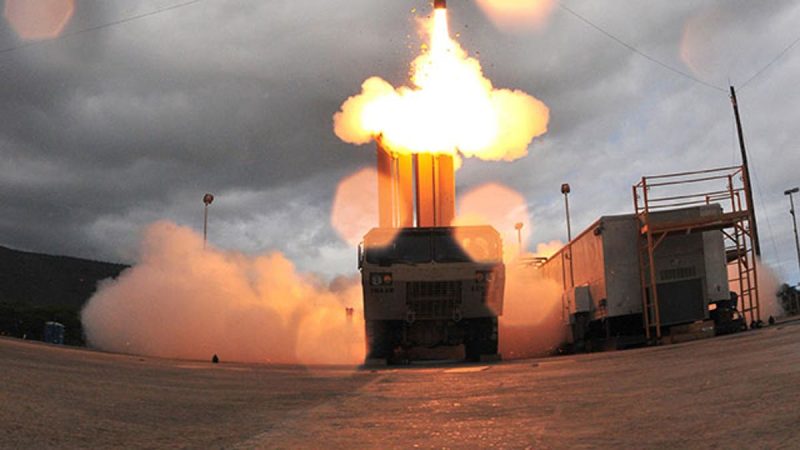
The U.S. is now more deeply entrenched in the conflict in the Middle East after a pivotal move to send troops to Israel was announced this week.
On Monday, the Biden administration revealed it would offer Israel one of the U.S.â€

Only U.S. troops can operate the system, and 100 of them will deploy to Israel. The Pentagon only has seven operable Terminal High-Altitude Area Defense (THAAD) batteries in its possession, and the one offered to Israel would presumably be among the seven.
Though Washington has armed Israel throughout its existence, putting boots on the ground for Israel’s defense is a rare departure from U.S. policy and the first U.S. deployment there since the outbreak of war after the Oct. 7 Hamas attack.
‘It’s a bit unprecedented,’ said EJ Kimpton, policy director at the U.S. Israel Education Association.
‘Israel’s mantra has been, you know, with ‘Never Again,â€
‘This would be the first time that U.S. personnel would be actively engaged in essentially fighting a war with Israel if Iran were to carry out additional strikes.’
From pushing Israel to a cease-fire, the U.S. has pivoted to containing the war in the Middle East, to seemingly accepting the fate of U.S. involvement in the conflict.
The U.S. has some 43,000 troops deployed elsewhere in the Middle East and recently sent a ‘few thousand’ to the region within the last few weeks to be ready to defend Israel if necessary.
‘It’s inescapable to see it as anything else [than escalation], the United States is now actually sending troops. We did not do that in Ukraine,’ Trita Parsi, vice president of the Quincy Institute for Responsible Statecraft, told Fox News Digital.
Sending U.S. troops to Ukraine is a non-starter in American discourse – a popular refrain among supporters is that such aid will prevent U.S. troops from ever having to put themselves in Russia’s line of fire.
‘We may end up having American casualties, and to put soldiers in that type of vulnerable situation for something that is not the defense of the United States itself, I think, is a very serious step taken by the administration,’ said Parsi.
In the past, Iranians have targeted military installations, including Israeli air defense systems. The THAAD system is expected to be able to intercept ballistic missiles launched from Iran and Yemen and shoot down any short-range missiles launched by Hezbollah from Lebanon.
Others question why the administration is supplying the system with no real off-ramp to the conflict or U.S. involvement in it. Israelâ€
‘Why are we keeping U.S. troops in harmâ€
‘The reality is, weâ€
The U.S. has some 2,500 troops in Iraq leading a coalition that provides extensive support to the Iraqi Security Forces to fight ISIS. But Iran has already tightened its grip on Baghdad and the mission its forces carry out.
The THAAD will assist Israelâ€
For two weeks, the world has waited to see how Israel responds to the 200 missiles Iran fired at the heart of Tel Aviv.
A violent showing from Israel might deter Iran from wanting to pick a larger battle. But in the Biden administrationâ€
President Biden may have offered the system as a way to coax Prime Minister Benjamin Netanyahu to follow his recommendation: to make sure Israel’s counterstrike to Iranâ€
‘I think the administration may be thinking that by offering this, they can convince the Israelis not to go that far,’ said Parsi.
‘If you truly want to put an end to this, then sending the same system that actually makes it easier for Israel to escalate is not the answer… Sometimes, it’s really difficult to discern who is actually making the policy and what is the policy.’
Netanyahu told Biden he was willing to strike military facilities when they spoke on the phone last week, according to a Washington Post report. But after that report, Netanyahu said in a statement he would not be making any decisions based on Biden’s insistence on proportionality. ‘We listen to the opinions of the United States, but we will make our final decisions based on our national interest.’