

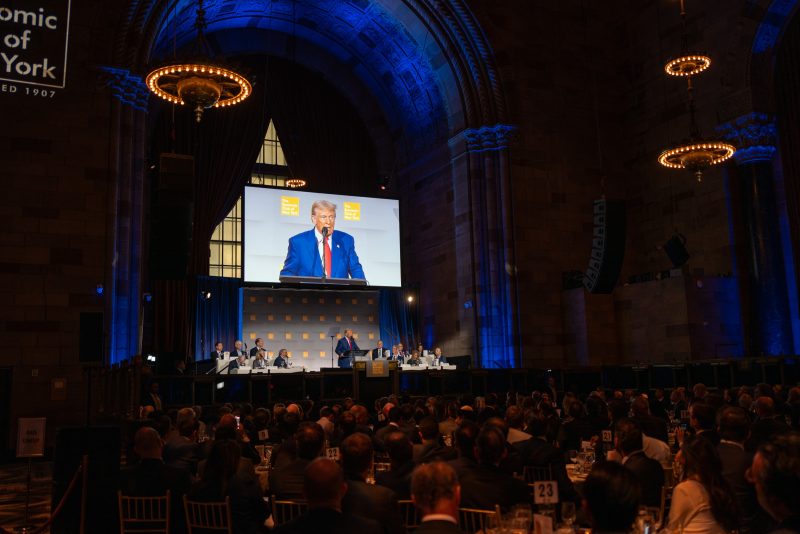
Before former president Donald Trump spoke to the Economic Club of New York this month, he prepped for the crowd of Wall Street power brokers and other traditional business elites who would be in attendance.
Trump consulted with Steven M. Mnuchin and David Malpass, his former treasury secretary and his appointee to lead the World Bank, two people familiar with the matter said. But then the Republican presidential nominee surprised his audience, calling in a speech for the creation of a U.S. sovereign wealth fund paid for by new revenue from sweeping tariffs on trade. Neither adviser had suggested that idea, the people said, speaking on the condition of anonymity to describe private conversations.
The gap between what Trumpâ€
On Capitol Hill, Republicans who support Trump but oppose his tariffs have downplayed his plans since his first run for president eight years ago, justifying them as necessary to bolster the U.S. position in global trade negotiations. This interpretation has also been popular among the conservative economic advisers close to Trump, who have embraced his tax cuts and pro-business agenda despite his protectionist instincts.
Trump floats tariffs “as a tool to get what we want,â€� Rep. Dan Meuser (R-Pa.) said in an interview. “Itâ€
But the former president has repeatedly undermined this view of his trade agenda, reiterating in his campaign speeches and proposals that he sees tariffs as a positive force for the U.S. economy rather than as a necessary evil.
Trump recently said tariffs “donâ€
“Tariffs are the greatest thing ever invented,� he said Tuesday night in Michigan.
After imposing tariffs on roughly $380 billion in imports during his first term, primarily on China, Trump is now calling for import duties of varying levels on all $3 trillion in U.S. imports — while also suggesting the revenue they bring in could be used to pay for some kind of unspecified national child care program and trillions of dollars in new tax cuts.
A handful of Republican senators have expressed their disapproval of Trumpâ€
“The Republican officials I talk to are hoping that this is just Trumpâ€
Republican National Committee spokeswoman Anna Kelly said Trump secured “the best trade deals in history� and would again advance an “America First� trade agenda.
“President Trump successfully imposed tariffs and negotiated new trade deals that leveled the playing field for American agriculture and manufacturing — allowing U.S. industries to send more made-in-America goods across the world,� Kelly said.
During his first term, Trump primarily pushed tariffs as necessary to counter Beijingâ€
Trump also picked trade battles with the European Union and imposed tariffs against Mexico and Canada as he renegotiated the North American Free Trade Agreement. But Republicans in the House and Senate, as well as the numerous free-trade proponents in his Cabinet, tried to keep these impulses in check. GOP Sens. Mitch McConnell (Ky.), Ron Johnson (Wis.) and Ted Cruz (Tex.) raised objections to his proposed tariffs on Mexico in 2019, for instance, while Mnuchin and former Trump White House economist Larry Kudlow sometimes worked to limit the scope of his trade plans.
Though controversial at the time, Democrats have since backed much of Trumpâ€
Since leaving office, however, Trump has dramatically intensified his trade rhetoric and proposals, fueling fears a second term would lead to a global trade war that Democrats are highly unlikely to ever back.
At the outset of the 2024 presidential race, Trump proposed a 10 percent “automatic� tariff on every U.S. trading partner, targeting all $3 trillion in annual imports. He said on television that he wanted to put a “ring around the collar� of the U.S. economy. In August, Trump suggested that the rate could instead be as high as 20 percent.
The nonpartisan Committee for a Responsible Federal Budget estimated the 10 percent universal tariff could raise $2.5 trillion in new federal revenue. A 20 percent tariff would raise significantly more, but not twice as much. Thatâ€
The economic consequences of such a measure could be severe. The median household would see its after-tax income fall by more than $2,600, or about 4.1 percent, according to an analysis by the Peterson Institute for International Economics, a Washington-based think tank. Thatâ€
But Trump has been unbowed, continuing to turn to tariffs as a kind of cure-all.
Asked at the Economic Club of New York about high child care costs, he cited tariff revenue as one potential answer. Trump also incorrectly said tariff revenue from his plans can be used to pay for roughly $7 trillion in new tax cuts. More recently, Trump floated using a “100 percent� tariff to force belligerent countries not to go to war.
“We donâ€
Sometimes, Trump characterizes this kind of effect as the purpose of the tariff — to bend foreign nations to Americaâ€
“So itâ€
GOP lawmakers have mostly chosen to believe this will form the crux of Trumpâ€
But Rep. Kevin Hern (R-Okla.), who chairs the Republican Study Committee, is one of many in the GOP who say they consider Trumpâ€
“Heâ€
Sen. Markwayne Mullin (R-Okla.) worked with Trump on trade policies when he was in the House. He said Trumpâ€
“So his whole thing is, if youâ€
Trump, however, continues to openly discuss tariffs in a different light.
During a speech in Pennsylvania this month, he said tariffs are “a tax on a country thatâ€
At the Economic Club of New York, Trump said tariffs “will combat inflation.� Economists say that even if tariffs lead to more domestic production, that would be the case only by making imports more expensive — which would mean higher inflation.
During a presidential debate, Trump responded to a question on tariffsâ€
“They arenâ€
While his exact intentions are hard to discern, Trump is leaving little room for interpretation — he clearly plans to use tariffs in a way that most Republicans will ultimately dislike, said Doug Holtz-Eakin, president of the American Action Forum, a center-right think tank.
“Should we be prepared for a Trump administration to levy across-the-board tariffs? Yes. How big will they be? How disruptive will they be? Who knows,â€� Holtz-Eakin said. “But Trump is not going to be put under control. Heâ€