

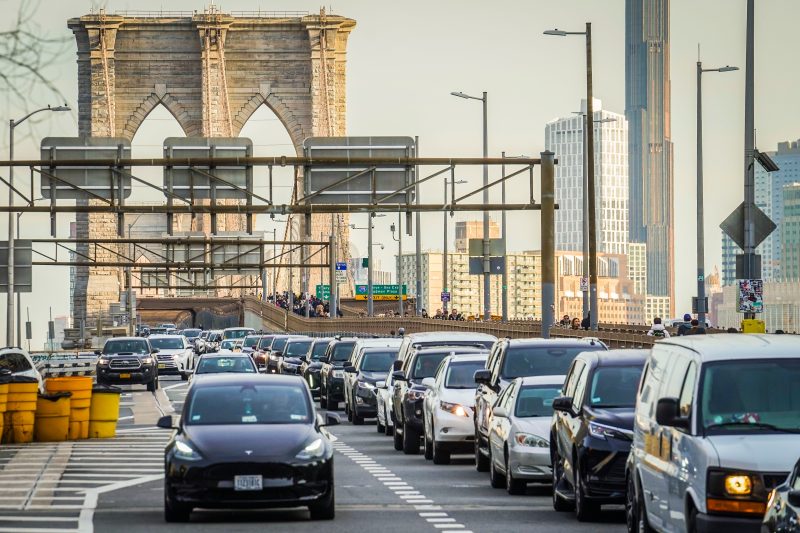
There were several reasons offered in support of the congestion pricing plan that was supposed to go into effect in New York at the end of the month. One was to address congestion — hence the name — by making it more expensive to bring a vehicle into parts of Manhattan. Another was to use the money raised from the program to improve public transit. Both outcomes contribute to another outcome: reduced greenhouse gas emissions as people switch from cars to trains and buses.
Despite having repeatedly and recently backed the proposal, New York Gov. Kathy Hochul (D) suddenly announced Wednesday that the plan would be put on indefinite hold. Her arguments for doing so were odd, suggesting either a fundamental misunderstanding of the proposal or an indifference to appearing that she misunderstood.
She offered a few arguments. Fewer people are coming into the city, hurting businesses such as restaurants that depend on workers, so they shouldnâ€
“Letâ€
There are a few important points here. One is that the plan would not apply to all of Manhattan, just the area south of 60th Street. That means that Central Park, Lincoln Center, many of the most famous museums — all of these would be exempt from congestion pricing. The fees charged would vary with size of vehicle and time of day, with certain periods incurring lower costs.
Perhaps the most important point is that there are many ways to get into Lower Manhattan without driving — and most commuters into Manhattan are already likely to avail themselves of those options.
The Census Bureau collects data on commuter movements around the country. The most recent data covers the five-year period from 2016 through 2020, but it gives us a good indication from where people who work in Manhattan originated.
Most originate from … within New York City. Thirty percent of Manhattan employees in that period lived in Manhattan. An additional 40 percent lived in the Bronx, Brooklyn or Queens. Very few of these workers presumably get to their jobs by driving; it is much more likely that they avail themselves of the cityâ€
About a quarter of those who come to work in Manhattan come from counties outside New York City. Many come from Long Island or Westchester County, to the cityâ€
It seems safe to assume that many are probably also not teachers or bodega owners. (A number of them may be first responders, however.)
On average, the 20 non-New York counties that sent the most commuters into Manhattan during that five-year period had median incomes that were in the 91st percentile of counties nationally. Several of the counties that sent the most non-New York/most-likely-to-drive commuters were in the 99th percentile, and had the highest median incomes of any counties in the country. A lot of the residents of those counties work in those counties, of course. But we can assume that many are non-middle-class people who work below 60th Street in Manhattan.
Itâ€
“This decision is about doing whatâ€
This is classic populist rhetoric, obviously, possibly cribbed from a book of Huey Long quotes. But it doesnâ€
“Those who commute by car to the CBD earn comparatively higher incomes: New York City DOT staff analyzed the income levels of city and suburban residents who use the automobile as their primary mode to reach Manhattan jobs,� it read. It concluded that, “in aggregate, the fee would most impact commuters who earn 31 percent more than the median income of all Manhattan workers.�
The little guy, as it were.