
After taking over the Democratic ticket, picking a running mate, staging a convention and turning in a strong debate performance, Vice President Kamala Harris is now embracing potentially the riskiest test of a presidential campaign — the day-to-day grind of unscripted interviews.
This week alone, Harris is appearing on CBS Newsâ€

From podcasts to town halls to late night shows and network sit-downs, Harris and Walz plan to spend much more of the final month before the election in situations they cannot fully control — after an initial two months when the vice president agreed to few such events.
At the core of the strategy is a reality that Democrats inside and outside her campaign have accepted: Harris is locked in a margin-of-error race, despite vastly outspending her opponent Donald Trump in advertising and field operations. Her campaign will soon lock in all its spending plans for the closing weeks. One of the few levers she has left to pull is putting herself before the audiences of other media outlets and influencers.
Such appearances always carry the risk of a misstep or ill-chosen phrase, but Harrisâ€
Like President Joe Biden, Harris has long been cautious and deliberate in her on-the-record press availability. As vice president, she conducted a few traditional sit-down interviews, but other events, sponsored by the White House, came with the benefit of prescreened questions and carefully chosen audiences. When Harris visited college campuses in 2023, her advisers regularly requested lists of prepared questions from students that she could preselect, according to emails obtained by The Washington Post via the Freedom of Information Act.
Even after the reelection campaign started, she was still undergoing media training and showing reluctance to face reporters without substantial preparation. But advisers say she has more recently embraced the need to go on more shows, and some recent appearances, including the friendly “Call Her Daddy� podcast interview, were considered notable successes by the campaign.
Advisers say the heightened focus on media exposure is part of a strategy in the campaignâ€
Instead, the Harris team has sought out media outlets popular with pivotal — and, it hopes, persuadable — groups such as younger voters, older Americans and Black and Latino audiences.
“If you consume political info, you want to consume political info,â€� Harris deputy campaign manager Rob Flaherty wrote Monday on social media. “Most of the remaining voters we need to talk to donâ€
The campaign may stage other events like last monthâ€
Through the first full month of her campaign, Harris benefited from a tightly-run operation, but one that was hamstrung by the suddenness of Bidenâ€
The Trump campaign tried from the outset to cast Harris as an unprepared candidate who meandered through interviews and could not answer basic questions. Her team declined to give that argument any fuel by risking adversarial interviews, choosing instead to stage Harris in scripted settings and refusing a traditional television interview until 38 days into her candidacy. Her favorability rating rose as she turned in strong performances at rallies, the Democratic National Convention and the presidential debate.
But the Harris campaign made clear as early as August that this calculation would change as Election Day approached. Harris had done only three television interviews by the end of September, according her campaign — on CNN, MSNBC and a local CBS station in Pittsburgh. She plans to do twice as many in the first nine days of October, including local broadcast appearances and national interviews with “60 Minutes,� “The View� and Colbert.
Eric Schultz, an adviser to former president Barack Obama, said Harris is wise to appear in both political and less-political venues. “I think now is the time when she is hitting her stride, so it makes sense,â€� Schultz said. “This is not zero sum. You can do â€
The Trump campaign, which is being outspent significantly in advertising, has long depended on its candidateâ€
The campaign regularly bans reporters from events to punish them for their reporting on Trump. The great majority of the former presidentâ€
Unlike Harris, who has largely avoided cable news, he has leaned into broadcasts that tend to appeal to political junkies — and to his base. Since mid-September, Trump has appeared at least 12 times on Fox News, Fox Business, Newsmax and Real America Voice.
Even so, the Trump campaign has sought to make an issue of Harrisâ€
Trump has made mocking Harrisâ€
“Did you see what happened the other day with the teleprompter with her? That was not a pretty sight. The teleprompter went off, and she went off, too,â€� he told the crowd at a Butler, Pa., rally Saturday, where he used his own teleprompter. “She didnâ€
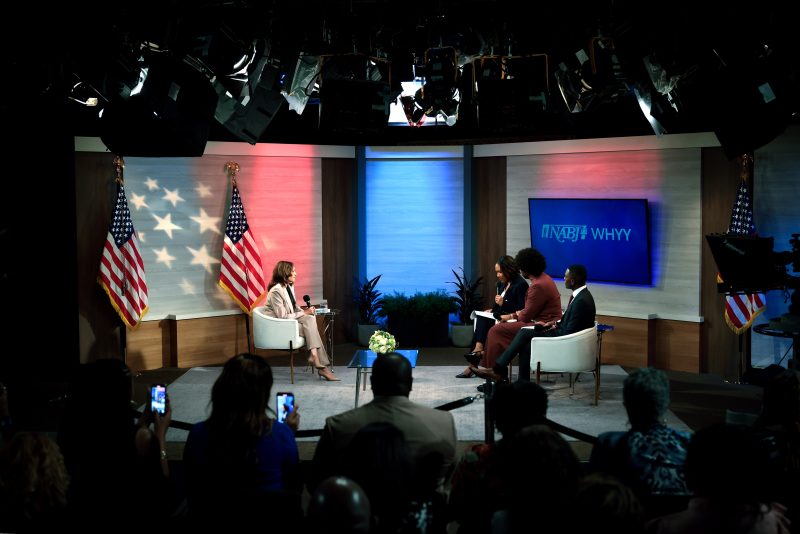
Despite its newfound openness to unscripted moments, the Harris campaign has continued to try to manage the environments she enters as a candidate. Before participating in the NABJ panel discussion, Harrisâ€
Before the “Call Her Daddy� podcast, host Alex Cooper made clear she had not been restricted by the campaign. “No topic was off-limits,� she said. Cooper and Harris spoke mostly about reproductive health and female empowerment, central topics of the podcast.
Two Black radio hosts said this summer that the Biden campaign had suggested questions before the president appeared on their shows. One of those hosts, Andrea Lawful-Sanders, acknowledged that Bidenâ€
Harrisâ€
“After we receive the questions, we will work with you and each student to choose one question per student from the 4 they drafted,� wrote a college official, relaying the instructions that had come from the White House.
Before an earlier visit to Reading Area Community College in Pennsylvania, a White House official wrote to the school asking for the “names of the students who draft the questions,� along with their “email, major, headshot and bio.�
Some of her recent exchanges are more spontaneous. In a brief back-and-forth with reporters on a tarmac outside Washington on Monday, Harris took a question about Republican Florida Gov. Ron DeSantisâ€
“People are in desperate need of political support right now, and playing political games in these crisis situations — these are the height of emergency situations — is just utterly irresponsible, and it is selfish,� she said.