
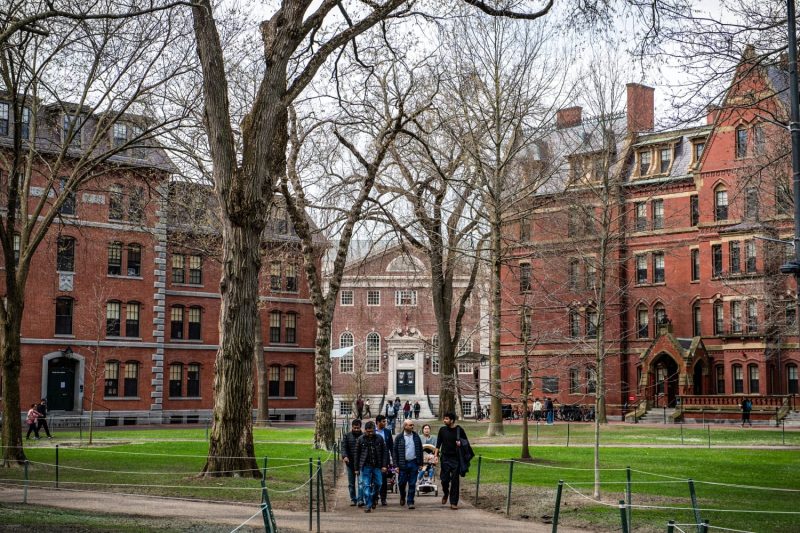
Harvardâ€

On April 14, Harvard University President Alan Garber announced the institution would not comply with the administrationâ€
According to CNN and multiple other news outlets, the Trump administration has now asked the Internal Revenue Service to revoke Harvardâ€
Bloomberg estimated the value of Harvardâ€
Nonprofits can lose their tax exemptions if the IRS determines they are engaging in political campaign activity or earning too much income from unrelated activities. Few universities have lost their non-profit status. One of the few examples was Christian institution Bob Jones University, which lost its tax exemption in 1983 for racially discriminatory policies.
White House spokesperson Harrison Fields told the Washington Post that the IRS started investigating Harvard before President Donald Trump suggested on Truth Social that the university should be taxed as a “political entity.� The Treasury Department did not reply to a request for comment from CNBC.
A Harvard spokesperson told CNBC that the government has “no legal basis to rescind Harvardâ€
“The government has long exempted universities from taxes in order to support their educational mission,� the spokesperson wrote in a statement. “Such an unprecedented action would endanger our ability to carry out our educational mission. It would result in diminished financial aid for students, abandonment of critical medical research programs, and lost opportunities for innovation. The unlawful use of this instrument more broadly would have grave consequences for the future of higher education in America.�
The federal government has challenged Harvard on yet another front, with the Department of Homeland Security threatening to stop international students from enrolling. The Student and Exchange Visitor Program is administered by Immigration and Customs Enforcement, which falls under the DHS.
International students make up more than a quarter of Harvardâ€
The Harvard spokesperson declined to comment to CNBC on whether the university would sue the administration over the federal funds or any other grounds. Lawyers Robert Hur of King & Spalding and William Burck of Quinn Emanuel are representing Harvard, stating in a letter to the federal government that its demands violate the First Amendment.
Harvard, the nationâ€
Harvard has an endowment of nearly $52 billion, averaging $2.1 million in endowed funds per student, according to a study by the National Association of College and University Business Officers, or NACUBO, and asset manager Commonfund.
That size makes it larger than than the GDP of many countries.
The endowment generated a 9.6% return last fiscal year, which ended June 30, according to the universityâ€
Founded in 1636, Harvard has had more time to accumulate assets as the nationâ€
Kimball, emeritus professor of philosophy and history of education at the Ohio State University, attributes the outsized wealth of elite universities like Harvard to a willingness to invest in riskier assets.
University endowments were traditionally invested very conservatively, but in the early 1950s Harvard shifted its allocation to 60% equities and 40% bonds, taking on more risk and creating the opportunity for more upside.
“Universities that didnâ€
Other universities soon followed suit, with Yale University in the 1990s pioneering what would become the “Yale Model� of investing in alternative assets like hedge funds and natural resources. Though it proved lucrative, only universities with large endowments could afford to take on the risk and due diligence that was needed to succeed in alternative investments, according to Kimball.
According to Harvardâ€
The university has made substantial portfolio allocation changes over the past seven years, the report notes. The Harvard Management Company has cut the endowmentâ€
University endowments, though occasionally staggering in size, are not slush funds. The pools are actually made up of hundreds or even thousands of smaller funds, the majority of which are restricted by donors to be dedicated to areas including professorships, scholarships or research.
Harvard has some 14,600 separate funds, 80% of which are restricted to specific purposes including financial aid and professorships. Last fiscal year, the endowment distributed $2.4 billion, 70% of which was subject to donorsâ€
“Most of that money was put in for a specific purpose,â€� Scott Bok, former chairman of the University of Pennsylvania, told CNBC in March. “Universities donâ€
Some of these restrictions are overplayed, according to former Northwestern University President Morton Schapiro.
“Itâ€
Harvard has $9.6 billion in endowed funds that are not subject to donor restrictions. The annual report notes that “while the University has no intention of doing so,� these assets “could be liquidated in the event of an unexpected disruption� under certain conditions.
Liquidating $9.6 billion in assets, nearly 20% of total endowed funds, would come at the cost of future cash flow, as the university would have less to invest.
Harvard did not respond to CNBCâ€
For now, Harvard is taking a hard look at its operating budget. In mid-March, the university started taking austerity measures, including a temporary hiring pause and denying admission to graduate students waitlisted for this upcoming fall.
Harvard is also issuing $750 million in taxable bonds due September 2035. This past February, the university issued $244 million in tax-exempt bonds. A slew of universities including Princeton and Colgate are also raising debt this spring.
So far, Moodyâ€