

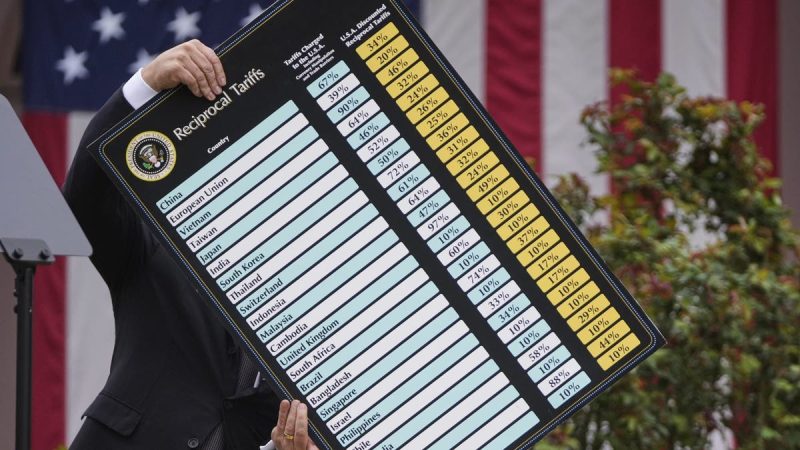
President Donald Trump laid out his plans for imposing a host of new tariffs on imports to the U.S. Wednesday — a day his administration touted as ‘Liberation Day’ and vowed would restore the American dream.
Trump unveiled the new tariffs in a ceremony at the White Houseâ€
‘For nations that treat us badly, we will calculate the combined rate of all their tariffs, nonmonetary barriers and other forms of cheating,’ Trump said Wednesday.
‘And because we are being very kind, we will charge them approximately half of what they are and have been charging us,’ he said. ‘So, the tariffs will be not a full reciprocal. I could have done that. Yes. But it would have been tough for a lot of countries.’
The Trump administrationâ€
The Trump administration previously imposed a 25% tariff on imported auto vehicles, up to 25% tariffs on certain goods from Mexico and Canada, as well as a 20% tariff on shipments from China. The White House said that tariffs already imposed on Canada and Mexico remain unaltered. However, new tariffs on China will be coupled with existing duties on Beijing.
Here is a look at the tariff rates that the Trump administration imposed as part of Liberation Day:
- China: 34% (not including previous 20% tariffs)
- European Union: 20%
- South Korea: 25%
- India: 26%
- Vietnam: 46%
- Taiwan: 32%
- Japan: 24%
- Thailand: 36%
- Switzerland: 31%
- Indonesia: 32%
- Malaysia: 24%
- Cambodia: 49%
- United Kingdom: 10%
- South Africa: 30%
- Brazil: 10%
- Bangladesh: 37%
- Singapore: 10%
- Israel: 17%
- Philippines: 17%
- Chile: 10%
- Australia: 10%
- Pakistan: 29%
- Turkey: 10%
- Sri Lanka: 44%
- Colombia: 10%
The Trump administration provided a chart of the tariff rates other countries charge on U.S. imports, suggesting that the tariffs the U.S. was imposing were not nearly as stringent as they could have been in order to reach reciprocity.
For example, the chart says that Japan has imposed a 46% tariff on U.S. goods, while the U.S. is only implementing a 24% tariff on Japanese goods imported to the U.S.
Why Trump wants tariffs
Trump and his administration have long railed against other countries’ trade practices and accused them of engaging in unfair trade practices against the U.S. — and argued that tariffs will help return manufacturing jobs to the U.S. As a result, he and his administration have called for employing tariffs to address the nationâ€
‘For decades, our country has been looted, pillaged, raped and plundered by nations near and far, both friend and foe alike,’ Trump said Wednesday.
Tariffs function as a tax that governments collect on foreign goods and services that manufacturers import. They are collected while undergoing customs clearance in foreign ports, according to the International Trade Administration.
The tariffs are expected to affect a host of goods, ranging from electronics, like iPhones that are predominantly manufactured in China, according to the Council on Foreign Relations, to wine and other alcoholic beverages originating from European Union countries, like Italy.
Trumpâ€
Specifically, the Senate moved to approve a resolution by a 51–48 margin Wednesday evening following Trumpâ€
Meanwhile, other countries have spoken out against the tariffs, including allies like Canada and Australia.
‘In our judgment, it will be negative on the U.S. economy that will have an impact on us,’ Canadian Prime Minister Mark Carney told reporters Wednesday.
Australian Prime Minister Anthony Albanese characterized the Trump administrationâ€
Meanwhile, Secretary of the Treasury Scott Bessent cautioned other countries against retaliating in response to the new tariffs, warning that the U.S. would not hesitate to take action again.
‘My advice to every country right now: Do not retaliate,’ Bessent said in an interview with Fox News on Wednesday. ‘If you retaliate, there will be escalation.’
The Associated Press and Fox Newsâ€