

The same day that the Supreme Court overturned federal protections for legal abortion in Dobbs v. Jackson Womenâ€
“We are issuing this proclamation to restore our state authority to regulate abortion and protect life,� Parson said. He went on to praise what “generations of Missourians have worked and prayed for,� victory in the “fight to protect innocent life.�
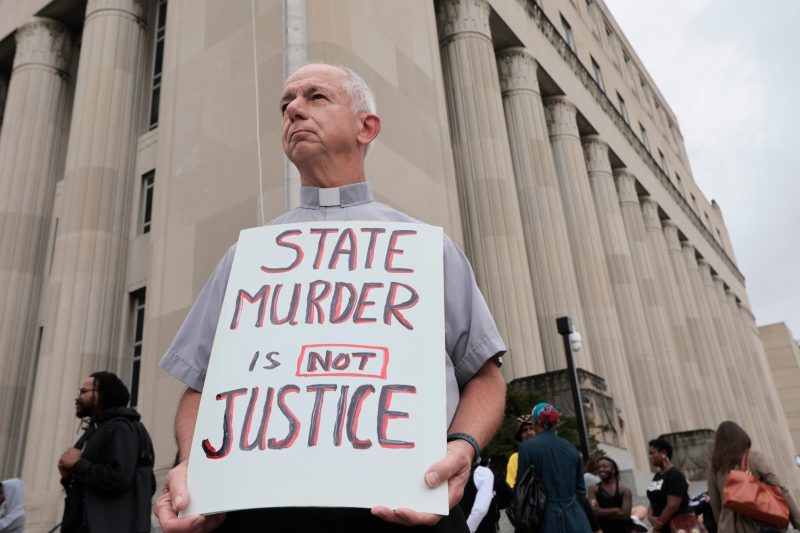
On Tuesday, Parson released a statement on a different but overlapping subject: the execution of Marcellus Williams for the 1998 murder of Felicia Gayle.
Williams insisted from the outset that he didnâ€
“We hope this gives finality to a case thatâ€
Americans generally donâ€
That said, very few Americans are consistently “pro-life� on these issues. The General Social Survey, a national poll usually conducted every two years, has been evaluating views of the death penalty and abortion for nearly half a century. About a quarter of Americans have consistently supported both capital punishment and the right of a woman to obtain an abortion for any reason. A smaller segment of the population sits at the other end of the spectrum, “pro-life� on both issues. Everyone else agrees with one or the other: the use of the death penalty or the availability of legal abortion.
Unsurprisingly, thereâ€
Forty years ago, the views of Democratic voters looked like those of Republicans. Over time, though, support for the death penalty declined on the left as support for abortion rose. In 1980, there were about 3.5 Democrats who supported the death penalty but opposed abortion for every Democrat who supported abortion but opposed the death penalty. Now, there are about 3.5 Democrats who support abortion and oppose the death penalty for every one who supports the death penalty and opposes abortion.
Because Democrats have more consistently opposed the death penalty, Democrats have been more consistently “pro-life� over the years than have Republicans by this measure.
Itâ€
While Democrats were more consistently “pro-life� until about 2000 (in part because Democrats were less likely to embrace capital punishment during the crime spike in the 1990s), about a quarter of Catholics both opposed capital punishment and abortion for most of the past 20 years. That has declined recently (as it has for other groups).
It is obviously overly neat to apply the term “pro-lifeâ€� in this way. Of course, advocates of legal abortion would argue that itâ€
Parson offers a particularly good example of the way in which Americans deploy that rhetoric in ways that, to an outside observer, might seem hard to understand. Over the past 40 years, though, it has consistently been the case that fewer than half of Americans oppose both abortion and the death penalty or support both. The majority holds diverging views — with some of them nonetheless adopting the mantle of “pro-life.�