

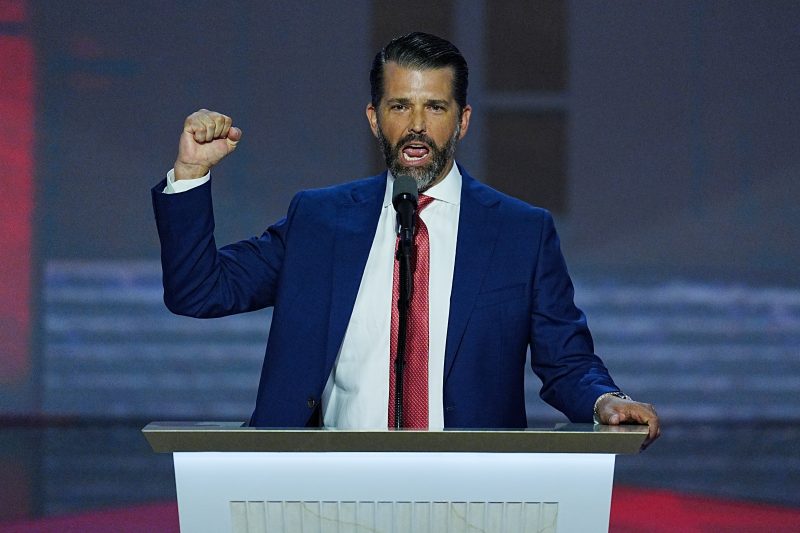
Last weekâ€
One comment made in a speech by the former presidentâ€
“There was a time when the Democrats really wanted what was best for America, even if they had a different way of getting there,â€� he said. “It was the party of Franklin Roosevelt, John F. Kennedy, Martin Luther King Jr. You may have disagreed with that party, but at least you could respect it.â€� He excoriated todayâ€
That comment, though, made me wonder how views of the two major parties and views of their candidates have overlapped over time. Is it the case that, whether the party has changed, views of the parties and their candidates have? (It also made me wonder when Republicans like Trump Jr. became willing to cede MLK to their opponents, but that’s neither here nor there.)
To answer that question, I turned to data from the American National Election Studies (ANES). The ANES is a poll conducted around every presidential election and includes questions asking Americans to rate the political parties and their candidates on a scale from 0 to 100. The pollsters refer to this as a “thermometer,� with 0 indicating very cold opinions and 100 very warm.
As you might expect, views of the parties correlate to views of the partiesâ€
Whatâ€
Look at the box in the top left corner of the chart below. It shows views of the Republican Party from cold to warm (left to right) and views of the Democratic presidential candidate in 1980 from cold to warm (top to bottom).
Those with the coldest views of the GOP had warm views of the Democratic candidate. But otherwise, itâ€
Scroll down to the 2020 box at the bottom of that column, and you see that those with strong positive views of the GOP now have strong negative views of the Democrat in the race. The same holds for the third column: views of the Democratic Party vs. views of the Republican presidential candidate.
(The winning candidate in each election is outlined in black.)
In fact, 40 years ago, it was common for those viewing the Democratic or Republican party very warmly to also view the opposing partyâ€
In 2020, almost none did.
We can visualize that another way. Particularly since 2004, views of the opposing partyâ€
This is in part because the number of people with positive views of the parties has also dropped. In 1980, only 6 percent of respondents rated the Democratic Party at or below a 24 on the 0-to-100 scale. Only 7 percent said the same of the Republican Party.
By 1996, that rose to 9 percent for the Democrats and 11 percent for the Republicans. By 2012, it was 19 percent and 25 percent respectively. In 2020, about a third of respondents rated each party that poorly.
Itâ€
Thatâ€