

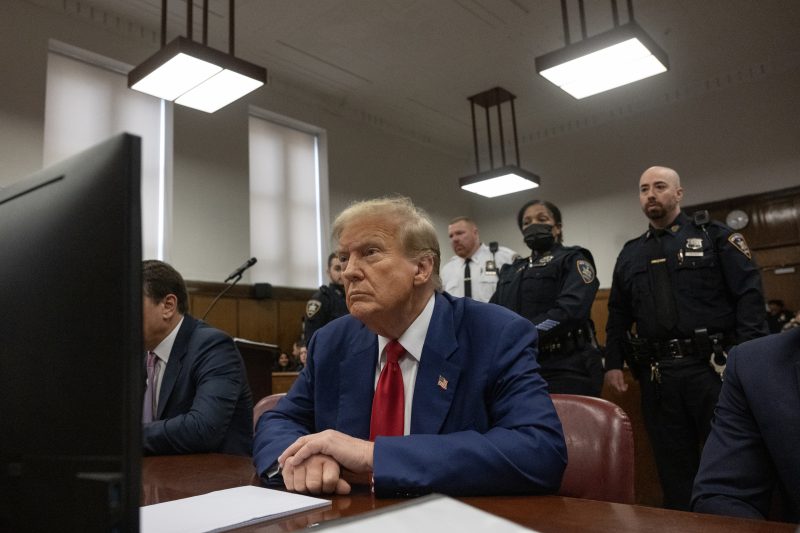
Donald Trump has complained of the indignities of a cold, uncomfortable Manhattan courtroom during his hush money trial, which began jury deliberations Wednesday morning.
If convicted, Trump could face other conditions he may consider insulting, including a required inmate review by New York Cityâ€
The probation office on the 10th floor of the Manhattan Criminal Courthouse prepares presentencing reports for judges. There, Trump would be interviewed about his personal history, his mental health and the circumstances that led to his conviction.
Lawyers say the process is humbling.
“If you think the courtroom is dingy, just wait until you go to the probation office,â€� said Daniel Horwitz, a white-collar criminal defense attorney in New York and former prosecutor in the Manhattan district attorneyâ€
Former prosecutors sketched out a mix of likely experiences for Trump if he were found guilty of any charge in the case, which includes 34 felony counts of falsifying business records. The case involves $130,000 in payments allegedly authorized by Trump to adult-film actress Stormy Daniels before the 2016 presidential election to keep her quiet about a sexual encounter she says they had.
The routine processing of convicted felons into the New York criminal justice system would include the timeline of a potential appeal. There would also be extraordinary considerations — such as how the Secret Service would protect him if he were sent to prison and whether he would be allowed to travel to campaign events if sentenced to home confinement — given Trumpâ€
Legal experts said incarceration appeared unlikely for Trump, 77, who has no criminal record.
The Class E felony charges are punishable by 16 months to four years in prison. Among the key issues to be determined if Trump were convicted would be whether he faces some form of incarceration, either in a government facility or a private location, or a less-restrictive experience through probation.
New York Mayor Eric Adams said this month that the cityâ€
A conviction would not disqualify him from running for office or serving as president if elected, constitutional experts said.
During the trial, which began April 15, prosecutors with Manhattan District Attorney Alvin Braggâ€
The jury, which heard closing arguments from defense lawyers and prosecutors Tuesday, must unanimously agree on a conviction or an acquittal, while a split among jurors could prompt New York Supreme Court Justice Juan Merchan to declare a mistrial. In that situation, Bragg could decide to retry Trump, who likely would paint the outcome as a victory in his efforts to discredit the prosecution as politically motivated.
Trumpâ€
If he is sentenced to probation, for example, Trump would be required to clear any out-of-state travel — such as to campaign rallies and fundraisers — with a probation officer. If Trump were to serve home confinement at his Mar-a-Lago resort in Palm Beach, Fla., New York authorities would likely have to work with counterparts in Florida to accommodate him, the experts said.
Such arrangements are not uncommon for convicted felons, experts said, but the details must be approved by probation officers.
“If you have a probation officer, you are not supposed to travel without permission. Your home is subject to random search because you donâ€
“That would be super awkward for someone on the campaign trail, but not impossible,â€� Galluzzo said. “If he had to go to a debate against Biden, he probably could go, but youâ€
Trump and Biden have agreed to two debates, the first scheduled for June 27 in Atlanta — which is likely to take place before any potential sentencing of Trump — and the second planned for Sept. 10 at a yet-undisclosed location.
Before a sentencing date were scheduled, Trumpâ€
Instead, the probation office would put together a presentencing report for Merchan. As part of that process, Trump would be required to participate in an interview with a probation officer who would produce a biography of him of about five or six pages, legal experts said. Such documents are confidential, intended only for the judge and the lawyers.
Trump has called his prosecution politically motivated and denigrated Merchan, Bragg and others, leading the judge to fine him 10 times for a total of $10,000 during the trial for violating a partial gag order. How Trump would react to questions from a probation officer about the case could get him into more hot water with the court. Legal experts said his lawyers likely would advise him not to discuss the case.
Convicts are “expected to tell the truth. If they are convicted and then say, ‘No, itâ€
The prosecution and Trumpâ€
Because he was charged with nonviolent crimes, Trump is an unlikely candidate to be detained in prison as he awaits sentencing, said the experts, who added that it is also unlikely that Merchan would impose bail as a condition for his release.
Trumpâ€
A key question is whether the court would agree to stay Trumpâ€
Former prosecutors suggested such a scenario is plausible given that any punishment of Trump could be short enough in duration that the sentence would be fully carried out before a legal appeal is litigated.
The legal experts said Merchan could grant Trump a conditional discharge tied to the requirement that he not commit another legal offense.
Merchan also could impose a financial penalty or require him to do community service or undergo counseling, some legal experts said.
If the judge were to impose a more onerous penalty, such as home confinement, Trump could still find ways to continue campaigning, even if he were not on the road.
“He could be confined but go to Mar-a-Lago and hold a news conference every day, be on TV, hold rallies remotely,â€� Horwitz said. “Thereâ€