
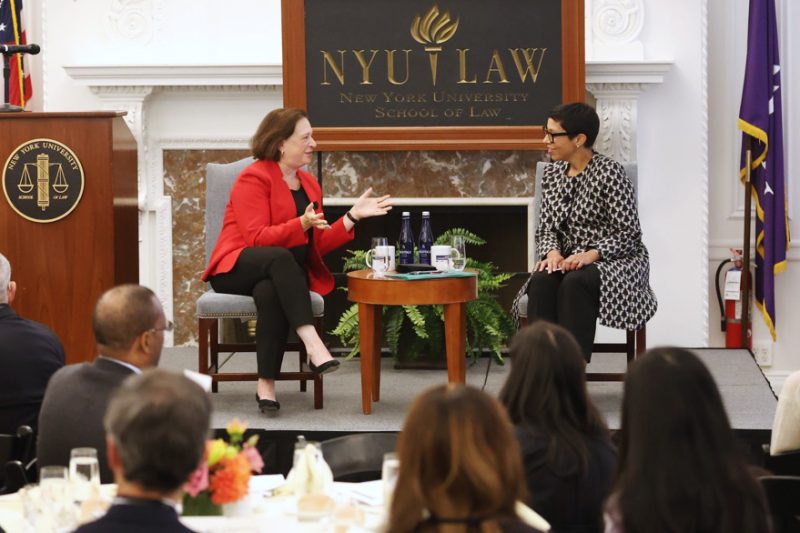
NEW YORK — Justice Elena Kagan on Monday brushed aside concerns about whether lower-court judges could effectively enforce the Supreme Courtâ€

“I just think judges are not so afraid of us,� Kagan said. “I think there are plenty of judges around this country who could do a task like that in a very fair-minded and serious way.�
Kagan was expanding on her recent suggestion that Chief Justice John G. Roberts Jr. appoint an outside panel of highly experienced judges to review allegations of wrongdoing or questions about recusal decisions by the justices, some of whom have faced questions in recent years over unreported gifts of luxury travel and potential conflicts of interest in key cases.
The court adopted a code of conduct specific to the nine justices last fall for the first time. But the policy was quickly panned because it does not include a way to examine alleged misconduct, review whether the justices have recused themselves when necessary, or clear or sanction justices who might violate the rules.
Having an oversight committee made up of well-respected lower-court judges “seems like a good idea to me in terms of ensuring that we comply with our code of conduct going forward in the future; it seems like a good idea in terms of ensuring that people have confidence that weâ€
The discussion touched on the historic number of women on the high court, collegiality among the justices and the rising number of requests for emergency action that can require the justices to quickly resolve complex issues — at least temporarily — without holding oral argument.
Kagan said she and her three female colleagues — Justices Sonia Sotomayor, Amy Coney Barrett and Ketanji Brown Jackson — have made their voices known on a court historically dominated by men. She noted that together the four of them speak more at oral argument than the five men on the bench.
“Weâ€
When asked about the decline in the number of cases on the Supreme Courtâ€
There are times, she said, that the court has to intervene quickly when the majority thinks a lower-court ruling is so out of step or involves such broad harm that the justices canâ€
Kagan is one of three justices nominated by a Democratic president on a bench with a conservative supermajority that has rapidly moved the law to the right. In the term that ended in July, Kagan was on the losing side in several high-profile cases, most notably when the majority granted Donald Trump broad immunity from prosecution for his official actions in the White House. She authored the dissent when the majority overturned a 40-year-old precedent to rein in the power of federal agencies to regulate major areas of American life.
The justices are preparing for another contentious term that will begin next month. Already on the docket are cases involving state bans on gender transition care for people younger than 18 and a challenge to the Biden administrationâ€
The new term will open as public confidence in the Supreme Court remains at historic lows. Seven in 10 Americans think the justices make decisions based on their own ideologies, rather than serving as an independent check on the government, according to an Associated Press-NORC poll released in June.
The court has been under intense scrutiny, with some justices facing questions about their off-the-bench conduct. In the case last term involving Trump, two justices — Clarence Thomas and Samuel A. Alito Jr.— dismissed calls to recuse themselves because of perceived potential conflicts of interest involving political activity by their wives.
President Joe Biden has proposed sweeping changes for the high court, including 18-year term limits for the justices and a binding, enforceable ethics code.
None of the justices have spoken out publicly about the term limits idea, but Kagan in July called for a committee of judges to enforce the ethics code, and Jackson has said she would also support some type of enforcement mechanism.
On Monday, Kagan was asked to respond to criticism of her proposed enforcement mechanism, including from Kelly Shackelford, president of the influential Christian conservative legal organization First Liberty. In a private conference call in late July, ProPublica reported, Shackelford characterized Kaganâ€
Kagan emphasized on Monday that she was referring to steps the court itself could take to ensure its rules are enforced. She has great confidence, she said, in the chief justiceâ€
Kagan joked that Shackelfordâ€
First Liberty Executive General Counsel Hiram Sasser told The Washington Post on Monday that Shackelford had sent a letter, dated Sept. 9, to apologize to Kagan for using an inappropriate term and for assuming she was inviting other branches in to control the court.