

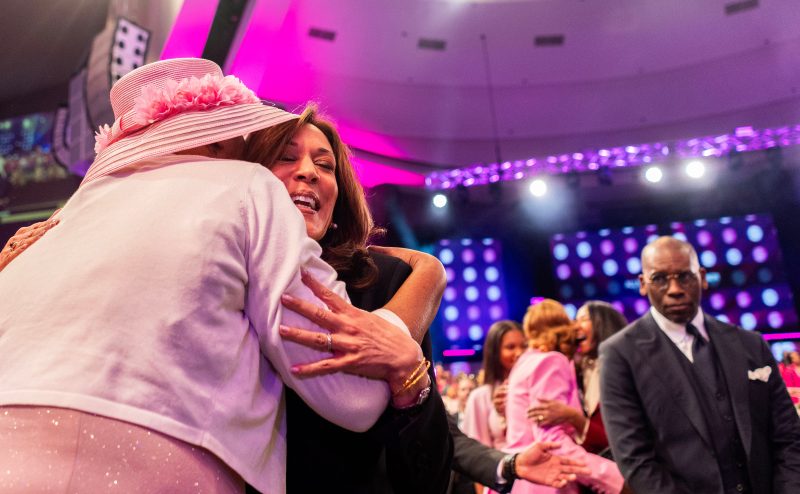
JONESBORO, Ga. — Kamala Harris spent the Sunday of her 60th birthday working to turn out Black voters in Georgia, where she asked congregants at two churches outside of Atlanta to choose between a country of “chaos, fear and hate� — represented, she implied, by former president Donald Trump — and the “country of freedom, compassion and justice� that she envisions.
Harrisâ€
The campaign still has work to do. Among Black registered voters, 72 percent of men and 85 percent of women support Harris, according to a recent Pew Research Center poll. Those are strong majorities, but Harrisâ€
Harrisâ€
Churches have long been key to Black civil rights and political organizing in the United States, and both the churches Harris visited Sunday are participating in her campaignâ€
The number of voters that campaigns can reach at Black churches, however, may be lower than it has been in the past. Black Protestant churches, like other churches across the country, have seen membership declines in recent years. The percentage of Black Protestants who say they generally attend church at least once a month dropped to 46 percent in 2022, down from 61 percent in 2019, according to a Pew survey.
The Harris campaign faces other challenges with Black voters. Many Black men have been frustrated by the economic pain caused by inflation during the Biden administration and disappointed by Democratsâ€
But Harrisâ€
At her first stop, at New Birth Missionary Baptist Church in Stonecrest Sunday morning, Harris told congregants that she was guided by the teachings of the Bible from an early age, and that growing up in the Black church in Oakland has shaped her leadership style. When Harris was a young girl, a close neighbor and family friend took her to the 23rd Avenue Church of God in Oakland, Calif., where she learned to live by the creed that God “asks us to speak up for those who cannot speak for the themselves� and to “defend the rights of the poor and the needy,� she said.
Wearing a skirt suit and a pink ribbon to commemorate “Pink Sunday� for breast cancer awareness, Harris said she learned from the parable of the good Samaritan that people of faith should “understand that in the face of a stranger, one should see a neighbor.�
She described the election as a consequential decision for people of faith, arguing that the “country is at a crossroads.� The question, the vice president said, is “what kind of country do we want to live in?�
“A country of chaos, fear and hate or a country of freedom, compassion and justice?� she asked. “The great thing about living in a democracy is that we the people have the power to answer that question. So let us answer, not just through our words but through our action and with our votes.�
At her second stop — a Souls to the Polls event at Divine Faith Ministries International where musician Stevie Wonder serenaded her with “Happy Birthday� — Harris again framed the election as a choice between a leader who would denigrate others and one who would seek to lift them up.
“Our strength is not based on who we put down as some would try to and suggest,� she said referring to Trump at her second stop in Jonesboro. “Our strength is based on who we lift up. And that spirit is very much at risk in these next 16 days.�
Sen. Raphael G. Warnock (D-Ga.), who spoke before Harris at Divine Faith Ministries, said he didnâ€
“The real threat is apathy — taking it for granted — thatâ€
“Weâ€
Warnock asked all the men in the Jonesboro church to stand. Then, speaking to Black women, he said, “Tell the brothers in your life, we need you to vote. If youâ€
Black voters will be the linchpin to Harrisâ€
“We are the backbone of the Democratic Party, and we will have Kamala Harrisâ€
Arndrea Waters King — the wife of Martin Luther King III, son of the civil rights icon — said she was deeply concerned about what is at stake for “little Black girls� like her own daughter. She criticized Trump for appointing three justices who helped overturn Roe v. Wade, the Supreme Court decision that protected abortion rights.
“Because of Donald Trump, my daughter — the only grandchild of Coretta Scott King and Martin Luther King Jr. — has fewer rights today than the day that she was born,� said Waters King, who is president of the Drum Major Institute.