
In the chaotic hours after former president Donald Trump was spirited offstage Saturday by Secret Service agents, his face streaked with blood, a doctored photo of the scene began bouncing around on X, falsely showing Trump with a wide smile.
The faked photo was held up as bolstering a baseless theory, promoted among some on the far left, that the shooting — deemed an attempted assassination by law enforcement — had been staged to boost Trumpâ€

Why is he so happy? https://t.co/xtXUEm9EDD
— Cheri Jacobus (@CheriJacobus) July 14, 2024
The altered image, like another one that showed the grimaces of Secret Service agents manipulated into grins, highlighted how the historic moment — captured live from multiple angles — was being warped online in real time, as social media users worked to skew the truth of what happened, win attention or score political points.
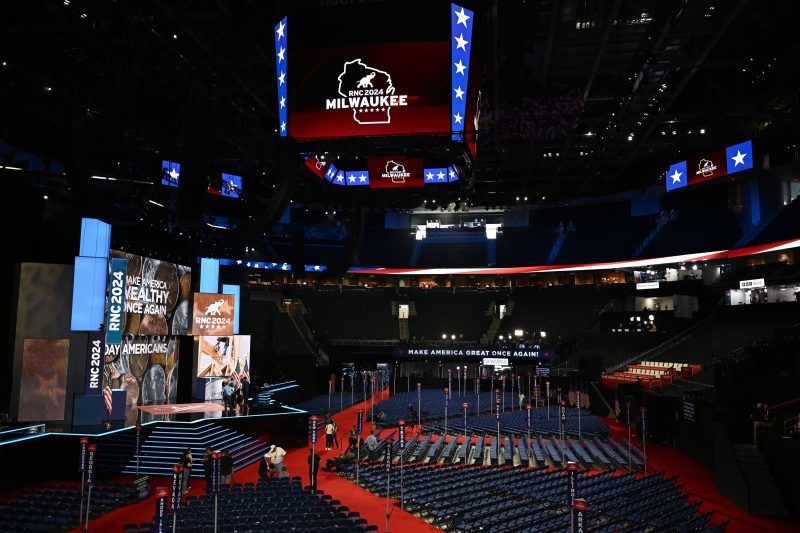
As the Republican National Convention in Milwaukee opens Monday, the confusion hasnâ€
While GOP delegates gather in Wisconsin, social media platforms are stoking false narratives amid the most divisive presidential campaign in recent history. Some of the biggest have backed away from moderating content, partly out of concern about drawing blowback for removing too much. Sites once lauded as places for views to be exchanged have increasingly become echo chambers for those with like-minded political views serving up falsities to bolster shared beliefs.
The conspiracy theories bubbling up on social media since Saturdayâ€
“The kind of content that goes viral is the content that is moral and emotional,â€� regardless of accuracy, and it can drive people to political extremes, Young said. After an event like Saturdayâ€
The flurry of false information threatened to muddle the public understanding of what happened ahead of the GOP convention, where Trump arrived Sunday. The presumptive Republican nominee is scheduled to address delegates Thursday, after a parade of GOP heavyweights, celebrities and Trump family members who are expected to demonstrate a party in lockstep behind Trump, especially in the wake of his close call in Pennsylvania.
Trump and his allies often draw political rhetoric from X and other social media platforms, foreshadowing the possibility that some of the claims could be repeated on the convention stage. Key speakers — including potential vice-presidential nominee Sen. J.D. Vance (R-Ohio) — took to social media to blame the assassination attempt on President Bidenâ€
Saturdayâ€
“Time to get to work[,] meme army,â€� said a post on the pro-Trump message board Patriots.win. The post included a cartoon comparing Trumpâ€
In the comments on one of Trumpâ€
In the aftermath of a shocking episode like Saturdayâ€
The welter of false theories isnâ€
“Misinformation is more resonant when social divisions and political divisions are starker and that always happens during a political campaign,â€� he said. “People have lost confidence in those sort of foundational facts and truths, and thatâ€
Social media is less policed and more fragmented than three years ago, when Biden and U.S. lawmakers promised a political reckoning in Silicon Valley following the Jan. 6 attack on the Capitol. In the immediate aftermath, Democrats criticized social media companies for providing Trump an online megaphone to make false claims about the results of the election, and law enforcement scrutinized the way the rioters used group chats and fringe platforms to organize the attack.
But Congress and the Biden administration ultimately did not develop new rules that would make tech giants more responsible for the violent screeds or falsehoods that circulate on their platforms. The Jan. 6 committeeâ€
Meanwhile, Republicans used their control of the House to investigate what they saw as systematic censorship of their views online, conducting a probe that eventually eroded some of the key academic programs and government initiatives to stem conspiracy theories and other falsehoods online.
Mainstream social media companies — including X, Meta and YouTube — have weakened or eliminated policy and programs meant to fight political misinformation. Following billionaire Elon Muskâ€
As Americans have grown increasingly polarized, Democrats and Republicans have started to consume and share social media content in more partisan ways. Right-leaning internet users often flocked to platforms such as Rumble, TruthSocial and Telegram to consume and spread commentary and information about the shooting while many on the left stuck to mainstream sites such as Instagram, Facebook and Twitter. Even mainstream social media sites such as Facebook can funnel people into environments where they mostly encounter news and opinions from people they agree with, research shows. After Musk bought Twitter, the share of Democrats who said the site was good for American democracy decreased while it increased for Republicans, according to the Pew Research Center, a Washington think tank.
Violent extremism has also increasingly moved to more opaque corners of the internet or services with lighter content moderation rules, after many companies deplatformed accounts that stoked the attack on the Capitol in 2021. In the immediate aftermath of the attempt on Trumpâ€
“War now. They donâ€
In the aftermath of the shooting, viral claims distorting the facts became almost impossible to ignore. Trumpâ€
One troll on X shared a video of himself lying that he had committed the crime and adding, “I hate Trump. And guess what, you got the wrong guy.â€� He later locked his account, but not before the video was circulated millions of times online, entrenching a false narrative about the shooterâ€
Musk has pledged that his platform, renamed X, is better at covering current events than the mainstream media due to its crowdsourced commentary from anonymous users and its speed of information flow. But the platform played host to some of the most viral strands of misinformation since the shooting, including the troll who purported to be the shooter in a video and received millions of views.
Some left-leaning accounts alleged without evidence that the shooting was fake, sending the word “stagedâ€� to Xâ€
Others alleged that the shooting was an “inside jobâ€� or that there was “evidence of a set-upâ€� by the “deep stateâ€� to remove Trump. Musk himself questioned whether the Secret Serviceâ€
Roger Stone, the longtime Trump confidant, falsely accused a man who was not Crooks of being the shooter, citing unnamed “sources,â€� in an X post Sunday. That man, whom The Washington Post is not naming, was an anti-Trump protester who pleaded guilty to charges stemming from a scuffle with police in 2016. By the time Stoneâ€
A separate man described as an “Antifa extremistâ€� was also falsely named as the shooter in posts that received millions of views. His name, Mark Violets, was briefly one of the top “trending topicsâ€� on X in the shootingâ€
Some of the posts with that false name included a photo of Marco Violi, an Italian soccer journalist. In an Instagram post, Violi said he was awoken in the middle of the night to numerous notifications about the allegations and that he intended to file a complaint about the accounts on X.
“I didn’t have the slightest idea of what had happened,â€� he wrote in Italian. The claims, he said, are “totally baseless and organized by a group of haters who have been ruining my life since 2018.â€�
Unproven claims about the shooterâ€
After Crooksâ€
Violent rhetoric tied to the assassination attempt is likely to increase online across the political spectrum in the coming weeks and months, said Graham Brookie, vice president for technology programs and strategy at the Atlantic Council, a Washington think tank.
“This is a very challenging moment of political violence in this country,� he said, “and platforms have to address this event as an act of violence as opposed to a political topic that is sensitive to engage on.�
Clara Ence Morse contributed to this report.