
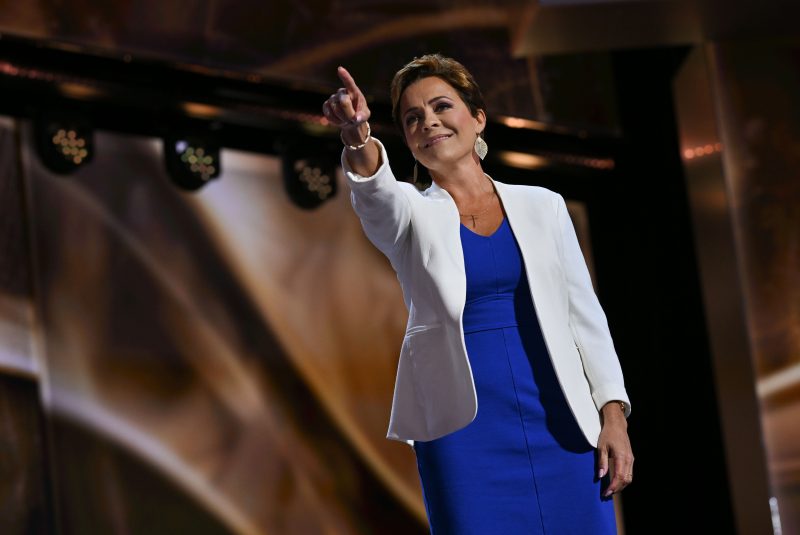
When Arizona Senate candidate Kari Lake came to the lectern of the Republican convention Tuesday, she began by extending an effusive welcome to everyone in attendance.
Well, almost everyone.
“Wait a minute. I donâ€

She was interrupted by cheers and applause.
“Frankly,� Lake continued, “you guys up there in the fake news have worn out your welcome, right?�
More cheers. More clapping. And why not? Picking on the media at a Republican convention is like praising the current city on an arena-rock tour.
The rest of Lakeâ€
It’s hard to underestimate the importance of this dynamic. Lake, like many Republicans, speaks primarily with supporters and sycophantic interviewers. Some of the hostility the right projects toward the media is performative, a politically valuable position. But some of it, too, stems from how jarring it is to occasionally encounter a mainstream reporter who isn’t willing to be steered to certain subjects or to avoid calling out falsehoods.
Rep. Marjorie Taylor Greene (R-Ga.) offered her own good example of this dynamic Tuesday.
Greene was speaking to a reporter about Trump’s selection of Sen. J.D. Vance (R-Ohio) to join his ticket, offering words of praise for the pick. Then the reporter pointed out that Vance had made an insulting comment about the U.K. and immigration.
“Well,â€� Greene replied, her voice indicating more agitation as she spoke, “letâ€
The reporter asked Greene if she had evidence of her claims about Democrats and the assassination attempt. Greene cut her off.
“Let’s talk about people like you that demonize people like me,â€� Greene said. “President Trump — you know, I have some of the most highest amount of death threats because of people like you, because you choose to only take certain words from people, and then that’s what you want to report. Shame on you.â€�
She asked a nearby aide where the reporter was from. The Times, the aide said, with the reporter noting that this was the Times of London. It’s not clear Greene heard that part.
“You’re from the Times, okay. You’re ridiculous. And you’re the problem in our country,â€� she fumed to the British reporter. “You lie about people like me.â€�
(The exchange was reminiscent of an interview Greene gave to a foreign outlet in June, during which she suggested that the Australian interviewer was “getting her marching orders from the Democrat Party.�)
“We have to put up with the most unreal amount of [nonsense] because of little liars like you that take your job and turn it into political activism,� Greene added a bit later to the Times reporter. “Your job is the press. You should report the news.�
The reporter pointed out that she was just asking for evidence. But Greene wasn’t done.
“Youâ€
Greene ended the interview. In a social media post sharing the exchange, she complained that there were “[l]ots of FAKE NEWS reporters at the RNC this week.�
On the convention floor Monday, Donald Trump Jr. had a similar exchange with MSNBCâ€
“Your father as president, I think even you would say, was a divisive figure,â€� Soboroff said to the former president’s son. “What’s it going to look like in a second term?â€�
“I don’t think he was a divisive figure at all,â€� Trump replied. “The media created divisiveness around him.â€� He cited purported examples, like the coverage of the investigation into Russian interference. “If the media actually starts being an honest broker, talking about the things that he did, the prosperity he brought, the peace deals that he signed around the world rather than the disaster that we’re living right now, I think you’d do everyone in the country a big favor.â€�
Soboroff, who has repeatedly covered the Trump administration policy of separating parents and children at the U.S.-Mexico border, asked if such a policy would resume in a second Trump administration. Trump tried to suggest that President Barack Obama originated the policy, which isnâ€
“Will there be a second family separation policy?� he asked.
Trump was visibly irritated.
“Itâ€
That “even todayâ€� line was an apparent reference to the proximity of the Saturday attempt on Donald Trump’s life, the one Greene blamed on the Times of London and other media.
In each case, we see how Trump loyalists view the media: Their job is to promote Donald Trump, the way that right-wing outlets and cable-news channels do. The reason many Americans view Trump negatively, in their estimation, is solely that reporters present non-positive information about Trump. If you only say nice things about him, people wonâ€
There’s a reason that the group most fervently supportive of Trump when he was president was Republicans who watched Fox News.
This is an exercise in futility, certainly, but imagine if Greene or Donald Trump Jr. had taken a different tack. If Greene, better accustomed to objective media interviews, had just answered the question, contextualizing Vanceâ€
Wisconsin Senate candidate Eric Hovde distilled his partyâ€
“We need to heal this country from the division that the left has brought. And, the media, you have to stop dividing us,� he said. “If we can come together, we will win Wisconsin.�
If the media stops dividing the country by providing positive and negative information about candidates and their candidacies, Republicans will win Wisconsin, Hovde argues.
That says more about the self-confidence of Hovdeâ€