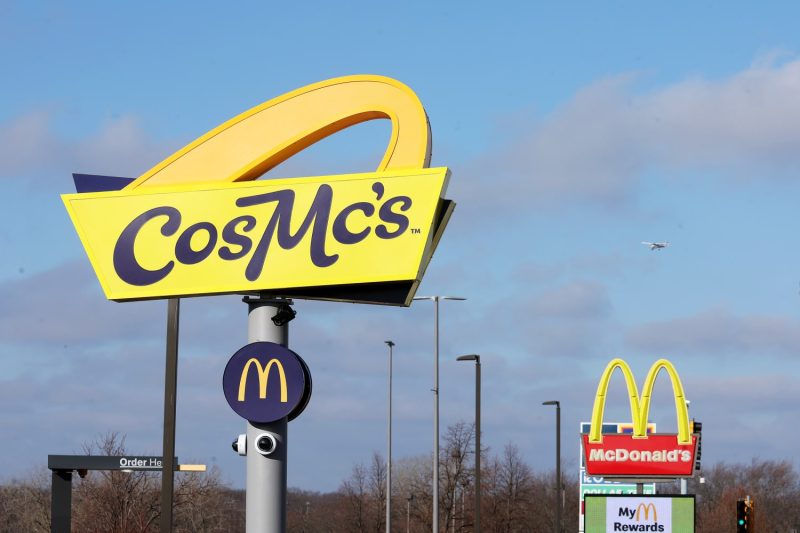
McDonald’s might never expand CosMc’s. But the spinoff could still pay dividends.
By
Published
Nearly six months since McDonaldâ€s opened its first CosMcâ€s location, the hours-long drive-thru lines have died down, but the chain is just getting started.
The burger giant created the spinoff using one of its lesser-known McDonaldland mascots, CosMc, an alien who loves McDonaldâ€s cheeseburgers. While unveiling CosMcâ€s at an investor event in December, McDonaldâ€s CEO Chris Kempczinski said the company set out to create a brand that could sell customizable drinks and coffee popular in the afternoon segment to attract younger consumers.
The new brand rollout comes as beverages are increasingly“looked at now as part of that snack area — more affordable, indulgent and perhaps even a healthier treat,â€� said Katie Belflower, an editor at restaurant research firm Technomic. “Itâ€s a good profit margin for restaurants. With beverages, you can get really creative, without necessarily having the product lines that you would have to invest in with food.â€�
Since opening the initial location in the Chicago suburb of Bolingbrook, McDonaldâ€s has opened three more CosMcâ€s restaurants, all in Texas. For now, the chain is planning to open 10 locations by the end of this year for a test run, with all but one located in the Lone Star State.
In another sign of the new brandâ€s expansion, it will launch its own mobile app and loyalty program, called CosMcâ€s Club, on Tuesday. Customers can use the app to place orders that they pick up either inside the restaurant or in the drive-thru lane. And loyalty program members earn 10 points for every dollar they spend; once they rack up 400 points, they can redeem them for $2 rewards.
While the long-term fate of CosMcâ€s is still too soon to tell, the gamble could pay off for McDonaldâ€s even if the spinoff never makes it past the 10-location test phase. The app and loyalty program will give the chain even more consumer insight.
“The cost of doing this, to McDonaldâ€s, is a rounding error. Even if they shut them all down six months from now, they still learn some things. Sometimes the learnings can be more valuable than you might imagine they would be,â€� Mark Kalinowski, restaurant industry analyst and chief executive of Kalinowski Equity Research, told CNBC.
At McDonaldâ€s December investor presentation, Kempczinski downplayed the short-term effect of CosMcâ€s.
“Let me emphasize again, weâ€re talking about 10 stores,â€� he said at the event. “The big story isnâ€t about CosMcâ€s, per se. The big story is what it says about McDonaldâ€s and our potential.â€�
But for many consumers, CosMcâ€s was the headline. When the first location opened days later in Illinois, eager customers waited for hours in drive-thru lines that dragged around the shopping center for the chance to buy McPops and Churro Frappes.
Weeks later, the buzz had started dying. According to Intouch Insight, the average wait time from entering the CosMcâ€s drive-thru line to reaching the speaker to order was 11 minutes and 13 seconds, based on visits from mystery shoppers in January and February. But the average service time, after ordering, was just four minutes and one second, trailing the industry benchmark by just six seconds.
On a Monday afternoon in May, there was no line for this CNBC reporter to reach one of the four drive-thru intercoms to place an order.
Investors†interest has also cooled as other parts of McDonaldâ€s business draw more attention.
“Six months ago, there was a lot of curiosity, but now that youâ€ve seen McDonaldâ€s same-store sales decelerate, thatâ€s where my clients†focus is,â€� Kalinowski said.
In the first quarter, McDonaldâ€s reported U.S. same-store sales growth of 2.5%, a slowdown as price increases fade and diners pull back their restaurant spending.
From the outside, the CosMcâ€s location in Bolingbrook isnâ€t much to look at. Four drive-thru lines await customers to place their orders. The buildingâ€s indigo exterior features the brandâ€s name — but no sign of its namesake mascot.
In fact, while CosMc plays an outsize role in the brandâ€s fictional origin story on the CosMcâ€s website, heâ€s basically invisible from its branding or restaurant.
“He is not as well-known of a character,â€� Belflower said. “I think thatâ€s almost to their benefit, because people can understand how CosMcâ€s is different from McDonaldâ€s itself — but it still has a retro font and coloring and things like that, so I think all of that helps tie it into the nostalgia.â€�
CosMcâ€s absence could also be due to the fact that the chainâ€s target customer likely wasnâ€t born yet when McDonaldâ€s advertisements featuring CosMc aired in the â€80′s and â€90â€s.
“Just in looking at the menu, it looks like itâ€s designed for half my age and under,â€� said Kalinowski, whose industry experience spans more than two decades.
CosMcâ€s customers can choose from a vast array of drinks and a smaller snack menu. Sour Cherry Energy Burst, Island Pick-Me-Up Punch and Popping Pear Slush are among the beverages that McDonaldâ€s created specifically for the chain.
Drinks, like a Tropical Spiceade, can be customized with “boosts,� like a vitamin C shot or an energy shot, tapioca pearls known as boba or a choice of eight different syrups. The chain also offers coffee drinks — like its Churro Cold Brew Frappe, whose largest size contains nearly five times the amount of caffeine found in an average cup of brewed coffee.
CosMcâ€s is also the latest example of a beverage-focused restaurant that doesnâ€t just sell coffee. Thereâ€s Utahan soda chain Swig, now majority-owned by Larry Millerâ€s family office. Dutch Bros gets about a quarter of its sales from its Blue Rebel energy drink. And Starbucks†Refreshers, first introduced a dozen years ago, are the chainâ€s fastest-growing beverage category in the U.S., with new spicy flavors available this spring.
Non-coffee drinks tend to appeal more to consumers looking for a pick-me-up in the afternoon. While they still might want caffeine, a flavored beverage like a Blueberry Ginger Boost from CosMcâ€s might be more appealing than another coffee.
CosMcâ€s level of customization would be difficult at a traditional McDonaldâ€s because it would slow down its drive-thru lanes too much. For example, Starbucks has credited the shift to cold drinks and pricy customizations, like cold foam, for its sales growth in recent years, but both customers and baristas have griped about complicated orders slowing service too much.
One way to speed up CosMcâ€s service could be using its digital menu boards differently. The CosMcâ€s menu board plays ads until a car pulls up next to the nearby intercom, leaving customers little time to ponder the menu of more than 70 drinks and food items. The launch of mobile and online ordering will likely also help speed up wait times.
Once customers finish ordering, they can pay at the speaker or wait to pay with a cashier at the pick-up window. CosMcâ€s also has customers wait by the intercom where they ordered until their order is ready to pick up. The menu board relays what pick-up window to drive up to grab the order.
Envisioned as a small-format location, CosMcâ€s doesnâ€t offer any in-restaurant seating, leaving it up to customers to sit in the 10-spot parking lot or keep driving. The Bolingbrook CosMcâ€s, a former Boston Market location, is much larger than McDonaldâ€s intends for the rest of the brandâ€s locations. But with empty real estate, a 45-minute drive from the companyâ€s Chicago headquarters and a traditional McDonaldâ€s right next door, it makes sense why the company chose that location as the first spot for the spinoff.
But the locationâ€s history is also a warning for McDonaldâ€s. The company bought Boston Market out of bankruptcy in 2000, intending to use its real estate. But it instead kept running the brand.
Seven years later, McDonaldâ€s sold it off, following a broader divestment in other secondary brands like Chipotle Mexican Grill. At the time, McDonaldâ€s sales were struggling, and executives blamed some of its woes on a lack of focus.
Extremist supporters of former president Donald Trump are lashing out online against Usha Vance, the wife of Trumpâ€s running mate, Sen. J.D. Vance (R-Ohio),...
Australia is home to a thriving tech sector with investment opportunities across a variety of subsectors. The tech sector contributed about AU$167 billion to...
Sister Stephanie Schmidt had a hunch about what her fellow nuns would discuss over dinner at their Erie, Pennsylvania, monastery on Wednesday night. The...