
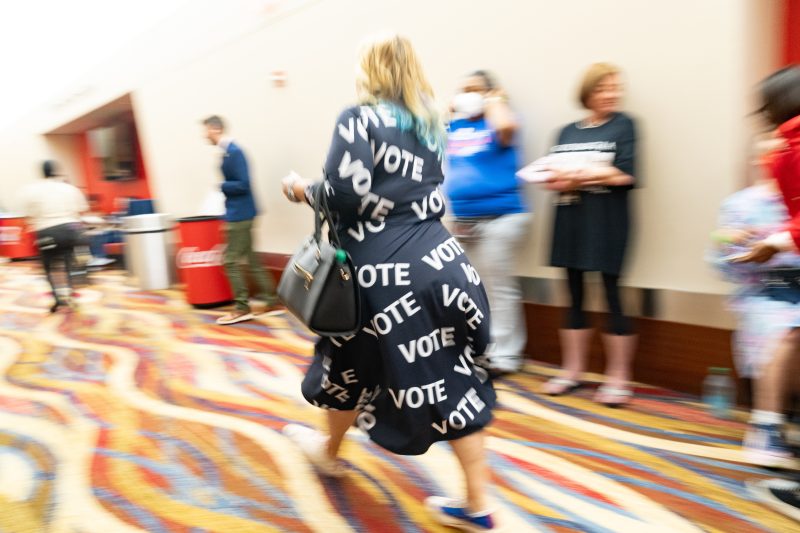
When considering how the presidential election is likely to turn out, there is no more important question than who will be motivated to cast a ballot. All of the talk of Vice President Kamala Harrisâ€

That question overlaps with the other defining aspect of the contest: that men and women appear to be unusually polarized on vote choice. Trump is running a campaign explicitly focused on getting more men (particularly young men) to vote. Harris, by contrast, is depending on women, often letting the historic nature of her bid serve as an implicit appeal.
But the 2024 election is also the first presidential contest to unfold in the post-Roe v. Wade world. In 2022, Democrats overperformed expectations in the midterms, an outcome attributed at times to turnout shifts driven by views on abortion access. In special elections — and particularly on ballot initiatives centered on abortion — abortionâ€
New polling from KFF reinforces the advantage Harris has both with women and on the issue of abortion. The pollsters went back to women they had interviewed in June, evaluating how their views of the race had shifted since Harris became the Democratic nominee.
Perhaps the most important shift appeared in the extent to which women expressed more motivation to vote than they usually felt. Overall, the percentage of women saying they were more motivated than normal jumped nearly 20 points, driven by a big surge among Democratic women. Democratic women were also far more likely to describe themselves as satisfied with the candidates for president than they were in June.
Relative to June, women were also more likely to say that the election would have a big impact on the issue of abortion. In fact, KFF found that women — including Republican women — thought it was likely that Trump would sign a national ban on abortion (should it come to his desk if he won in November) and that Harris would sign a law codifying the protections of Roe.
Certainly some Republican women would see a national abortion ban as good and abortion protections as a negative. Two-thirds of women, though, oppose such a ban. (Trump has said he wouldnâ€
Thereâ€
Those nonvoters were disproportionately non-White. KFFâ€
Voters are notoriously bad at predicting whether they will actually vote. Harrisâ€