
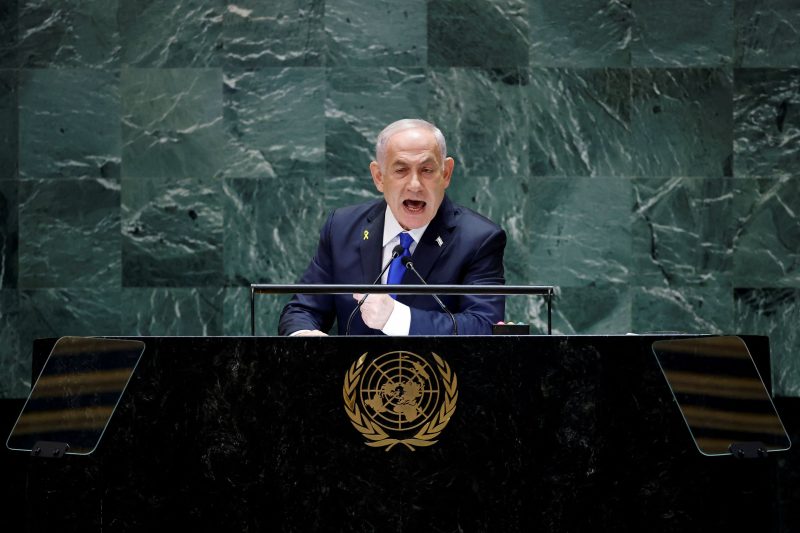
NEW YORK — Israeli Prime Minister Benjamin Netanyahu vowed during a fiery address to the U.N. General Assembly on Friday that his country would continue its military operation in Lebanon in defiance of a U.S. cease-fire proposal demanding a temporary halt in hostilities between Israel and Hezbollah.
His swaggering, bellicose remarks included a warning to all of Israelâ€

“If you strike us, we will strike you,â€� Netanyahu said. “There is no place in Iran that the long arm of Israel cannot reach, and thatâ€
Netanyahuâ€
Netanyahu said Israel is “winningâ€� and pledged to keep fighting. “Weâ€
Netanyahuâ€
White House spokesman John Kirby was asked repeatedly Thursday why Netanyahu kept contradicting a proposal that the U.S. claimed had his support, but was unable to offer an answer other than to say that the prime ministerâ€
“What prompted the prime ministerâ€
Inside the U.N. assembly hall here in Manhattan, scores of diplomats walked out on Netanyahuâ€
Outside the U.N., thousands of demonstrators rallied in Manhattan to protest Israelâ€
“Our enemies seek not only to destroy us, they seek to destroy our common civilization and return all of us to a dark age of tyranny and terror,� Netanyahu said.
Richard Gowan, a U.N. expert at the International Crisis Group, said Netanyahuâ€
“Netanyahu, like Trump, has always understood that these U.N. speeches are opportunities to generate catchphrases and memes. He is not that bothered by what the diplomatic audience thinks. He is doing this for domestic media and his U.S. audience,â€� said Gowan, referencing former president Donald Trump, the Republican nominee in Novemberâ€
The Israeli leaderâ€
“We will fight until we achieve victory, total victory. There is no substitute for it,� Netanyahu said.
Netanyahuâ€
In solidarity with Hamas, Hezbollah began firing rockets into Israel on Oct. 8, leading to an increasingly deadly military escalation between the two warring sides over the last year.
President Joe Biden had tapped his top aides to broker a temporary cease-fire during the annual gathering of diplomats at the U.N. General Assembly, prompting a flurry of meetings by Secretary of State Antony Blinken and national security adviser Jake Sullivan with Israeli, European and Middle East diplomats.
Croatian Prime Minister Andrej Plenkovic told The Washington Post that “partnership� between the United States and Europe on preventing a “wide escalation� in Lebanon is critical. But the proposal, endorsed by a wide range of allies including the European Union, France, Australia, Canada, Qatar, Saudi Arabia and Japan, appeared destined to languish without more pressure on both sides to de-escalate.
Karen DeYoung, Adam Taylor and Sammy Westfall in Washington contributed to this report.