
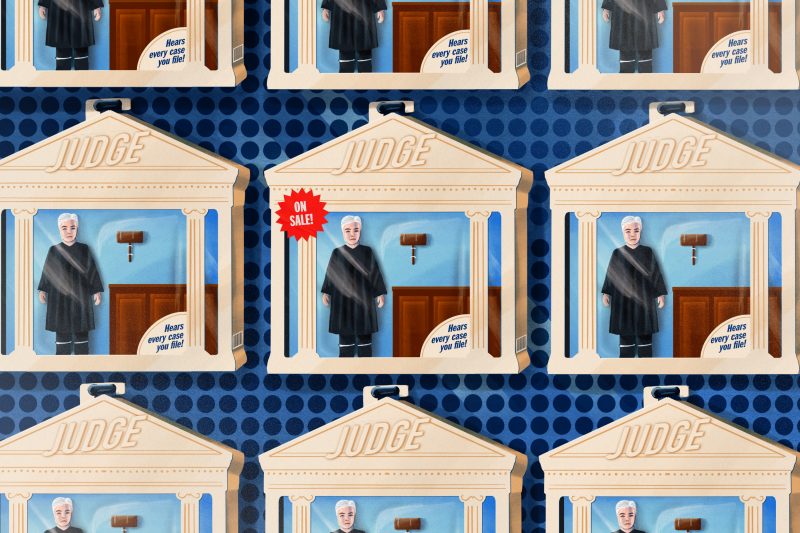
Leaders of the federal court system and some members of Congress are trying to limit the practice of judge shopping — when a person or group files a lawsuit in a carefully chosen court where they believe the judge will be inclined to rule in their favor.
But none of the proposed changes seem within reach.
A Democratic bill introduced this spring would require cases to be randomly assigned among all judges within a federal court district, even if the suit is filed in a courthouse that has only one judge. A Republican bill would limit when judges can block policies nationwide. Guidance issued in March by the policymaking body that oversees the courts said cases with statewide or nationwide implications should be assigned randomly.
Neither the Democratic nor Republican legislation seems likely to advance in a polarized Congress, however. And the policymaking bodyâ€

In the meantime, conservative judges who appear to have been intentionally chosen by plaintiffs continue to act in high-profile cases, blocking Biden administration rules to protect transgender students and to require background checks for gun-show purchases, among other decisions. Liberal judges who seemed to have been targeted by Democratic attorneys general did some of the same during the Trump administration, including on immigration policy.
“Any practice that allows litigants to manipulate the court in a way that makes the court look like they are simply doing the bidding of one side of the ideological spectrum — thatâ€
He and other legal experts said chief judges must work to ensure that the public trust the courts to be fair and neutral. A few judicial districts have taken steps to address the issue in their own way, eliminating single-judge divisions or creating new rules for some cases.
“This is going to play out probably fairly messily,â€� said Russell Wheeler of the Brookings Institution. “And youâ€
The history of judge shopping
Judge shopping drew national attention in 2021 because of the large concentration of patent cases — nearly a quarter — being filed in the Waco federal courthouse in the Western District of Texas, where Alan Albright is the sole judge.
Patent plaintiffs found a number of Albrightâ€
In 2021, Sen. Thom Tillis (R-N.C.) and then-senator Patrick J. Leahy (D-Vt.) wrote to Chief Justice John G. Roberts Jr. asking for reforms. Weeks later, Roberts, who oversees the Judicial Conference, called for the study of judicial assignment practices in patent cases.
After the fall of Roe v. Wade in 2022, an antiabortion group chose a rural Texas courthouse to challenge the federal governmentâ€
Republican officials and conservative groups have also used single-judge divisions — which contain just one courthouse and only one active federal judge — to challenge Biden administration policies on LGBTQ+ rights, immigration and gun control, among other hot-button issues.
At the same time, federal judges in Alabama found that attorneys at major LGBTQ+ rights groups and law firms, including the American Civil Liberties Union, engaged in judge shopping when challenging the stateâ€
The lawyers filed lawsuits in the Northern and Middle districts of Alabama in 2022, then voluntarily dismissed their cases when they were not assigned to a judge they thought would be sympathetic. The lawyers “purposefully attempted to circumvent the random case assignment procedures,� the report said.
In an address to the Midland County Bar Association, Judge James C. Ho of the U.S. Court of Appeals for the 5th Circuit, said liberal and conservative litigants alike use judge shopping to “zealously advocate for their clients.�
“Letâ€
But Vladeck said the practice is far more common among conservative activists and officials, in part because single-judge courthouses are overwhelmingly located in sparsely populated parts of red states whose judicial appointees are more conservative.
Vladeck has tracked at least 46 Texas lawsuits challenging Biden administration policies in the stateâ€
Proposals to address judge shopping
In March, the Judicial Conference asked courts to randomly assign cases that have statewide or nationwide implications throughout an entire judicial district, instead of within a smaller division or courthouse.
“Public confidence in the case assignment process requires transparency,â€� the bodyâ€
But the conferenceâ€
Once that reality became clear, Senate Majority Leader Charles E. Schumer (D-N.Y.) — along with more than three dozen other Democrats — introduced legislation that would codify the conferenceâ€
“The American people need to believe in the fairness of our judicial branch, and this legislation would move our legal system in the right direction,â€� Schumer said in April. “We canâ€
That same day, Senate Minority Leader Mitch McConnell (R-Ky.) introduced a bill that would limit the authority of district courts to provide injunctive relief only to the parties involved in a particular lawsuit, or others who are “similarly situated� and located in the same judicial district. The bill would also sanction lawyers accused of judge shopping and set new limits on where patent and bankruptcy cases can be filed.
Neither bill has advanced.
Several federal judges were unwilling to answer questions about judge shopping, with one saying the issue has become “highly politicized.� Those who did speak expressed concerns about the legislation and how the random case assignment policy would impact their work — especially in a large state like Texas, where courthouses are far apart and judges would have to travel to the courthouse where a lawsuit was filed if that case was randomly assigned to them.
“Mandating something like this that would require judges to travel 500 miles or 400 miles to a different duty station and listen to a month-long or two-month-long trial is just not how we manage our docket or our taxpayer expenses,� said Chief Judge Randy Crane of the Southern District of Texas, which has one single-judge courthouse — in Galveston — and decided in May not to adopt the guidance on random case assignments.
“I believe our court runs efficiently as is,â€� Crane said. “I donâ€
He separately expressed concerns about McConnellâ€
“Everybodyâ€
Retired Texas federal judge W. Royal Furgeson Jr. said random case assignment would also be very challenging in the Northern and Western districts of Texas. “Itâ€
In the Northern District, Kacsmaryk, Reed Oâ€
Making their own changes
Current and retired federal judges say they know their districts best and that the judiciary will sort itself out. This happened in the Southern District of Texas, the Western District of Texas and the Western District of Louisiana.
There used to be two single-judge divisions in the Southern District of Texas. In Victoria, Tex., U.S. District Judge Drew B. Tipton received all civil and criminal cases, including several high-stakes immigration cases. Like Kacsmarykâ€
But in 2023, Tipton was transferred to the Houston Division and two judges in Corpus Christi picked up his Victoria cases. While Crane, the chief judge, said the transfer was not in response to judge-shopping complaints, the move ended one of the most significant hubs for the practice in the state.
In Galveston, the other single-judge division in the district, Judge Jeffrey V. Brown acknowledged in a statement that “judge-shopping is an issue of concern.â€� His chambers said he issued an order in December that plaintiffs must explain their caseâ€
Crane said there has been no case filed in Galveston seeking nationwide relief on any issue since Brown put the new procedure in place.
In the Western District of Texas, the number of patent cases declined by about 41 percent in 2023 after the chief judge directed them to be randomly assigned — a response to Robertsâ€
In Louisiana, Terry A. Doughty used to be the only judge in his courthouse in Monroe. In 2023, two other judges started taking some cases filed there following concerns about judge shopping, though Doughty — the chief judge of the Western District — still handles about 70 percent.
Judges in the district decided not to adopt the random case assignment policy because each division now has more than one judge, Doughty said. In 2023, he blocked the federal government from communicating with social media companies — a decision rejected by the Supreme Court this summer on procedural grounds.
In the Lake Charles Division of the district, Judge James D. Cain Jr. hears 90 percent of civil cases filed, while Judge David C. Joseph only hears 10 percent. A Trump appointee with a history of upending Bidenâ€
The government had asked Cain to dismiss the case for lack of jurisdiction.