

Almost immediately after the presidential debate ended Tuesday, former president Donald Trump proclaimed victory.
This was inevitable, certainly. He did the same thing after debating President Joe Biden in June, but that was at least a contest in which he was obviously the more successful participant. On Tuesday, he was not — but then, he hadnâ€
Late Wednesday night, Trump moved on to broadly declaring himself successful.
“People are just starting to give me credit for having a GREAT DEBATE. The Voters and Voter Polls showed it, but the Fake News Media wasnâ€
This has not been my impression. I was curious, though, where the claim about evangelicals came from. The answer, happily, came from scrolling down a bit in Trumpâ€
Shortly before that post, he had reposted something from journalist David Brody. Brody pointed to data from Pew Research Center showing that, as he put it, Trump was “up 82%_16%.�
“Thatâ€
This is not the assumption I would make. Trump is a well-known entity in general but particularly among White evangelical Protestants. Itâ€
Nor is the Pew number particularly “phenomenal.â€� Pew has also developed estimates of support by religion over the past two presidential elections. In 2016, Trump won White evangelical Protestants by 77 percent to 16 percent. In 2020, it was 84 percent to 15 percent. The pollâ€
That level of support, though, reflects how important the evangelical vote was to Trumpâ€
Trumpâ€
Research from PRRI has identified how central the support of White Christians is to Trumpâ€
In 2016 and 2020, about a fifth of the presidential electorate identified as White evangelical Protestants — overperforming their presence in the population. In those same elections, about a quarter of voters were unaffiliated, agnostic or atheist.
One takeaway here is that Trump is, once again, misreading polls. The Pew poll that Brody highlighted was completed Sept. 2, more than a week before the debate. It does not in any way have people saying “WOW� about how impressed evangelicals were with that encounter.
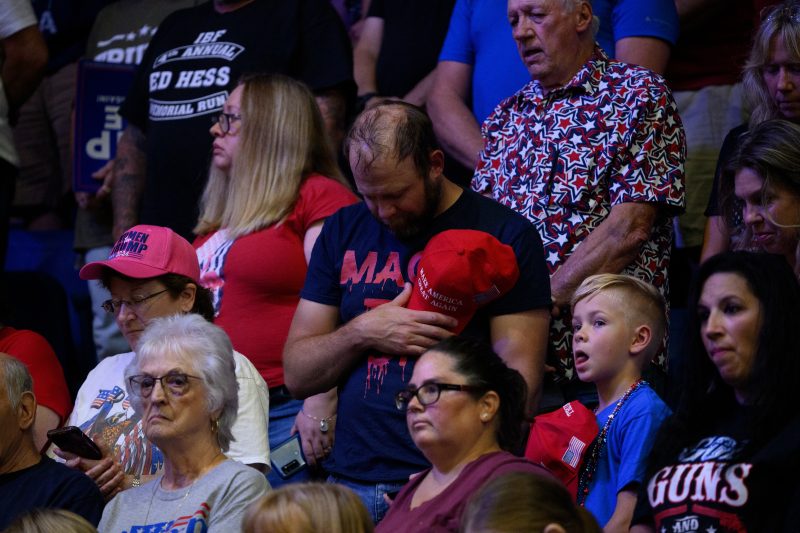
Another takeaway is that Trump continues to understand that his political future depends on those religious voters.
Speaking to television host Phil McGraw this month, Trump suggested that his survival after coming under fire during a rally in Pennsylvania two months ago was a sign of divine intervention. Asked by McGraw if he thought there was a reason he lived, Trump said that “the only thing I can think is that God loves our country. And he thinks weâ€
The attack has frequently been presented in religious terms by his supporters, from almost the moment that it occurred. A giant flag draped behind the stage where he spoke was briefly tangled before the attack unfolded, for example; his supporters now suggest that its appearance, vaguely resembling an angel, was a sign of providence. Even when he was president, most evangelicals said they thought Trump was selected by God to serve. To many of them, the assassination attempt merely demonstrates it.
The religious aspect is unquestionably one reason that Trump and his allies seek to keep the assassination attempt at the forefront of the publicâ€
Trump is not particularly religious himself (to force the word “particularlyâ€� to play a role of significant understatement). But he knows both that his base is strongly religious and that they are concerned about the status of religion in American society. Heâ€