

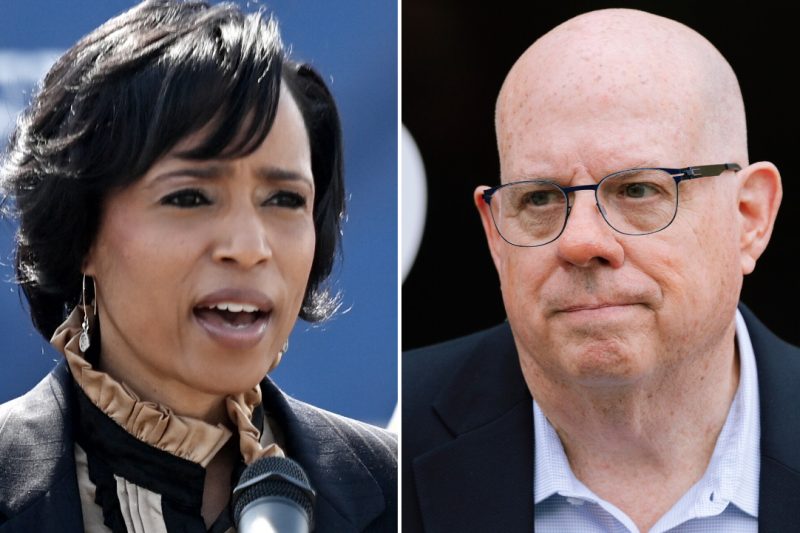
Democrat Angela Alsobrooks has pulled clearly ahead in Marylandâ€
Alsobrooks leads Republican Larry Hogan — a former governor elected twice in the deep-blue state — by 11 percentage points among likely voters, even though the poll shows Hogan has won over a sizable portion of Democrats and remains about as popular with voters as his rival.
With tens of millions of dollars yet to be spent on the airwaves, a debate ahead and national attention locked on to the race, Alsobrooksâ€
Democrats outnumber Republicans in Maryland by more than 2 to 1. Independent voters, including those affiliated with the Green and Libertarian parties, make up nearly a quarter of the electorate and typically swing for Democratic candidates in presidential elections but have helped Republicans win three out of the last six governorâ€
“The task for Alsobrooks is pretty challenging because a lot of Democrats have a favorable opinion of Hogan, and changing that is not necessarily easy,â€� said University of Maryland political scientist Michael Hanmer, director of the universityâ€
Marylandâ€
Maryland has not elected a Republican to the Senate in four decades and President Joe Biden won here by 33 percentage points in 2020. Yet, Hoganâ€
Democratic voters and moderates switching allegiance from Hogan to Alsobrooks have been key to Alsobrooksâ€
Alsobrooks, who started her political career as the Prince Georgeâ€
In particular, sheâ€
Jay Anderson, 73 and a retiree who lives on Kent Island, is a swing voter who twice cast a ballot for Hogan for governor. This time, heâ€
“I like Larry Hogan. I voted for him. But Iâ€
He added that he cannot trust that Hogan will be able to remain independent amid intense political pressure from the rest of the GOP. “I donâ€
While Anderson doesnâ€
Control of the Senate has been a key message from Alsobrooks and her Democratic allies, including the pro-abortion rights group Emilyâ€
Democrats spent heavily to frame a vote for Hogan as empowerment of the Republican Party and a threat to core Democratic priorities, particularly reproductive rights. Hogan and his allies, also spending millions, have told voters heâ€
In some ways, Hoganâ€
But he is still trailing by a significant margin — albeit similar to when he was trailing in polls in 2014 before pulling off an upset win.
“Thereâ€
Alsobrooks is polling better in the vote-rich, Democratic-leaning suburbs of D.C. and in Baltimore, while tied with Hogan in other central Maryland counties and behind him in the more rural stretches of the state.
“I like her, I think she can be very strong,â€� said Tiffany Navas, a 33-year-old engineer who lives in Annapolis who said sheâ€
Eileen Thornton, 54, who lives in Laurel, said her plan right now is to split her ticket and vote Harris for president and Hogan for Senate. But she finds herself continuing to weigh which Senate nominee will vote most sensibly. A lifelong Maryland resident and registered Democrat married to a registered Republican, Thornton said Hogan won her over with his “down-to-earth� personality and his track record governing the state during the coronavirus pandemic.
“I like Larry Hogan better,â€� she said, adding: “This is dire. I better watch what Iâ€
In other ways, Hoganâ€
Overall, Maryland voters strongly favor abortion access: 75 percent say abortion should be legal in all or most cases. Hanmer said that after the Supreme Courtâ€
“With the Dobbs decision, the game just completely changed. And you have to be specific now,� he said.
Over 4 in 10 voters, 43 percent, say abortion is an extremely important factor in their choice of Senate candidate this fall. Maryland voters also find other issues important: 55 percent say the economy is extremely important, 50 percent say health care is, and 61 percent say the same about protecting American democracy, the highest share for any issue measured.
More voters say Alsobrooks would do a better job handling abortion than Hogan, 53 percent to 24 percent. Alsobrooks has a lead over Hogan on handling health care and protecting American democracy, as well. Slightly more voters trust Hogan on the economy, 42 percent to 38 percent for Alsobrooks, but he does not have an advantage over Alsobrooks on any other issues measured.
The former governor has seen his sky-high favorability ratings — a record among Maryland governors — decline 11 points over the six months of heated campaigning, while more people have warmed to Alsobrooks. Her favorability rating has almost doubled, from 26 percent favorable in March to 50 percent now, while Hoganâ€
Both are viewed significantly more favorably than Sen. Chris Van Hollen (D-Md.), who has been in public office in Maryland since 1991. Half of voters have no opinion of him, while 33 percent view him favorably and 18 percent unfavorably.
Hamner said he had expected Alsobrooks to make gains as she became more recognized, but not by this much. “Those margins are much bigger than I would have expectedâ€� he said, attributing the shift to widespread enthusiasm among Democrats after Harris became the presidential nominee. “In a state like Maryland, where you have such a strong base or such a large base of Democrats … youâ€
The more Silver Spring resident Erik Hubscher learns about Alsobooks, the more he likes her. The 29-year-old recent college graduate said he fears the consequences of another Trump presidency and a Republican majority in the Senate.
“I did not know much about her [before],� Hubscher said. “But the more I research about her, she pretty much goes along with a lot of Democratic values and policies, which I am looking for.�
This Post-UMD poll, conducted Sept. 19-23, has a plus or minus 3.5 percentage point margin of error. The survey was conducted among 1,012 registered voters randomly sampled from a statewide voter database. Sixty-two percent of interviews were reached by live callers to cellphones, 16 percent on landlines and 22 percent were completed online via a text invitation.
Lateshia Beachum contributed to this report.