
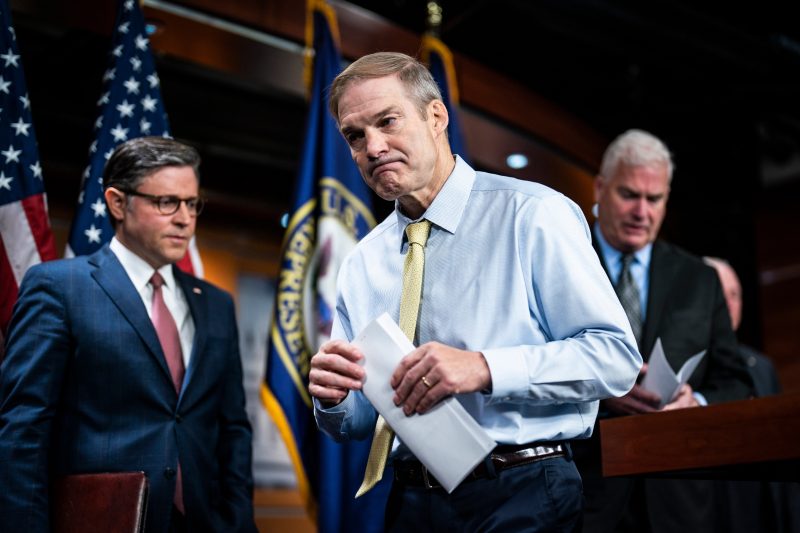
Rep. Jim Jordan (R-Ohio) is not known for being generous with moderate colleagues. During the earliest days of his two decades in the House, the far-right firebrand often ignored, or publicly defied, the more centrist members of his party.
But with his sights again set on the highest echelon of House Republican leadership, Jordan seems eager to make amends.
He is steering clear of the intraparty fights he once seemed to relish, selling himself as a potential bridge between House Republicans and the MAGA front line, and raising — and sharing — a lot more money with his colleagues, including a significant investment to House Republicansâ€

This cycle, Jordan has given a hefty sum — $1.7 million — to the NRCC and contributed to a range of campaigns. Itâ€
Jordanâ€
It is not yet clear if he has a shot. Much depends, of course, on the outcome of the election, particularly whether Donald Trump wins the presidency and who controls the House. Jordan has not publicly stated his ambitions and declined to comment for this article.
But a review of his fundraising and interviews with dozens of GOP lawmakers and aides suggest he is making an early and informal play on the chance that the unruly and often times ungovernable GOP conference loses its majority in November or that the conference becomes so disenchanted with Speaker Mike Johnson (R-La.) that its members look for an alternative.
“It is clearly obvious that everyone is positioning for what might be next,� said Rep. Marcus J. Molinaro (R-N.Y.), who voted against Jordan once it became clear he had no pathway to becoming House speaker and has since invited him to campaign in his swing district.
Jordanâ€
Jordanâ€
For Jordan, it was a moment when he realized he doesnâ€
“Jordanâ€
Of those Republicans that publicly voted against Jordan on the House floor during the messy speakerâ€
Rep. Kelly Armstrong (R-N.D.), an ally of House leadership and a fan of Jordan, said Jordan has “evolved and matured so much� in the six years the North Dakotan has been in office and calls his positioning for leadership so far “smart.�
This is not the first time Jordan has had his sights on competing for the top leadership spot — he challenged McCarthy for minority leader after the 2018 midterms. After Jordan lost, winning only 43 votes in a secret ballot, McCarthy and other Republicans advised Jordan that if he wanted to rise through the ranks of House leadership, he needed to step up his fundraising for all of his colleagues, according to two people familiar with the meeting, who spoke on the condition of anonymity to detail a private discussion.
He started to fundraise for more ideologically diverse Republicans, but it was not until 2022 — when he was vying to become House Judiciary Committee chairman if Republicans regained the majority — that he donated $100,000 to the NRCC, his first donation to help House Republicans.
The refusal by roughly two dozen Republicans to elect him as speaker last year was the impetus for Jordan to get serious, spending time away from Washington campaigning for Republicans and cutting fundraising checks to colleagues for the first time.
This cycle, Jordan has given to 23 Republicans representing swing districts since October 2023 — when Jordan lost his speakership race — through June 2024, which is the last time campaign finance reports were filed to the Federal Election Commission.
One of the people Jordan donated to for the first time is Rep. Don Bacon (R-Neb.), a moderate who represents a district Biden won by more than 6 percent in 2020. Bacon voted against Jordan for speaker last year and received threatening phone calls and emails because of it, an episode that further soured their already frosty relationship.
Now, Bacon says heâ€
Jordan has shocked many pragmatic Republicans who supported his candidacy — including moderate Rep. Dave Joyce (R), a fellow Ohioan — by cutting checks for their campaigns for the first time. Jordan also donated to Rep. Tom Cole (R-Okla.), an influential committee chairman, who was challenged by a far-right candidate supported in the primary by the Freedom Caucusâ€
Jordan has also been campaigning for members, who often invite him to their districts to rile up the GOP base.
“I think Jimâ€
It would be quite the pivot. Jordan was elected in his conservative district in 2006. In his first term, he led a group of antiestablishment Republicans to tank President George W. Bushâ€
In 2015, he co-founded the ultraconservative House Freedom Caucus to represent a new generation of rugged, just-say-no Republicans who blocked compromise, pressured two GOP speakers — Paul D. Ryan (Wis.) and John Boehner (Ohio) — to resign, and refused to help his less dogmatic Republican colleagues win reelection, including by refusing to pay mandatory dues to the House Republicansâ€
Not everyone will be ready to work with him. Some Republicans still remain irate and may not ever support him in leadership because of how he comported himself during the last speakership election. After a bitter falling out during the speakership fight last year, Jordan refused to fully endorse Scalise when the conference elected their majority leader to succeed McCarthy, which prompted a backlash among ardent Scalise allies. And Jordanâ€
Others just donâ€
But several lawmakers who were skeptical of him last year have become more open-minded about the idea because Jordan could play the role of messaging bulldog in the minority, especially if Vice President Kamala Harris becomes president.
“I never close the door on things,â€� said Rep. Carlos A. Gimenez (R-Fla.). “For me and Jordan, it was never personal. I just didnâ€