
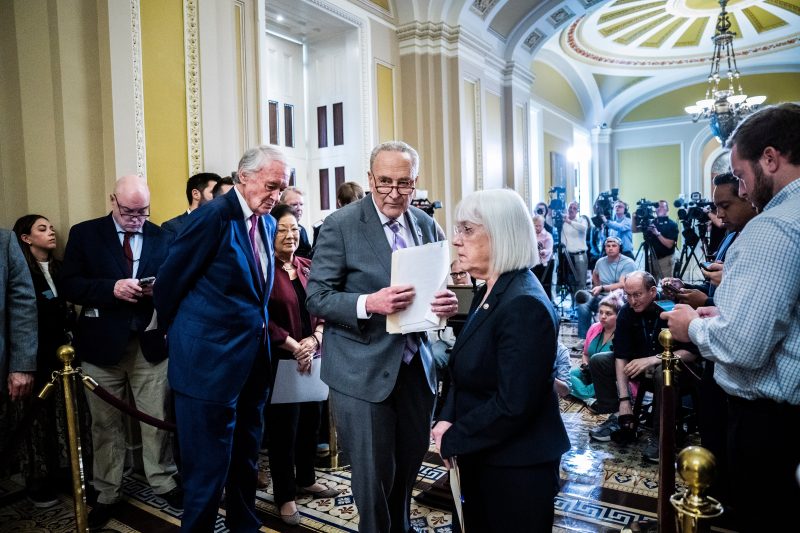
The Senate is expected to vote down a bill Wednesday that would create a federal right to contraception access after many Republicans said they oppose the legislation as unnecessary and government overreach.
The Democratic bill — intended to put Republicans on the spot in an election year on their unpopular positions on reproductive rights — would prevent states from passing laws that limit access to contraception, including hormonal birth control and intrauterine devices. It needs 60 votes to proceed to a vote on the underlying legislation.
The vote is likely to be one of several that Senate Majority Leader Charles E. Schumer (D-N.Y.) will tee up on reproductive rights as he seeks to protect a raft of vulnerable Democratic incumbents running in red and purple states this November.
The Senate may next take up legislation to protect access to in vitro fertilization, commonly known as IVF, Schumer said this week. In the GOP-led House, Rep. Kathy Manning (D-N.C.) introduced a discharge petition to attempt to force a vote on the same contraception bill, although itâ€

Reproductive rights have become a political liability for Republicans in the wake of the Supreme Courtâ€
Access to contraception enjoys broad support. A 2023 Gallup poll found that 88 percent of Americans said birth control was morally acceptable, including 86 percent of Republicans and 93 percent of Democrats.
Republicans say the bill is intended to raise fears about a threat to contraception that does not exist. They also say the measure does not contain adequate religious freedom protections for providers who object to certain birth-control methods.
The National Republican Senatorial Committee sent a memo to GOP Senate candidates this week urging them to express support for increased access to birth control in the form of an alternate bill put forward by Sen. Joni Ernst (R-Iowa).
“Republicans support access to birth control. Democrats are trying to make this a campaign issue and scare voters because they canâ€
Democrats pointed to Republican opposition to contraception legislation — including GOP Gov. Glenn Youngkin of Virginia vetoing a similar bill last month — as evidence that the effort is necessary. Some Republican lawmakers in Oklahoma also pushed legislation that could have outlawed intrauterine devices, and some Republicans oppose the “morning-after pill� that helps prevent pregnancies. Former president Donald Trump recently said he was “looking into� whether he supported restrictions on birth control, but later clarified that he would “never� support a birth-control ban or restrictions.
“Theyâ€
Sen. John Cornyn (R-Texas) called it a “show vote� and said he would be voting against it.
“Itâ€
Ernst, who also opposes the bill, introduced legislation to encourage more birth-control methods to be developed that can be sold over the counter. The legislation does not apply to the morning-after pill, which Ernst said is a “red line� for many Republicans.
“Theirs is fearmongering, mine is actual solutions,� Ernst said of the bills.
Republicans also raised concerns that the Democratic bill did not include religious or conscience exemptions for providers who are opposed to some kinds of contraception. The billâ€
Sen. Susan Collins (R-Maine), who supports abortion rights, said this week that she would probably vote to proceed on the bill, despite feeling it was mainly a political messaging device by Democrats.
An outside group, Americans for Contraception, said that after the vote, it would spend $7 million to “educate, inform and empower voters on where their officials stand on contraception.�
Democrats have cast Republicans as trying to take away womenâ€
“Every day another woman is confronted with the agonizing reality that she does not have control over her own body,� said Sen. Patty Murray (D-Wash.). “That Republican politicians are forcing her to remain pregnant.�
Marianna Sotomayor contributed to this report.