

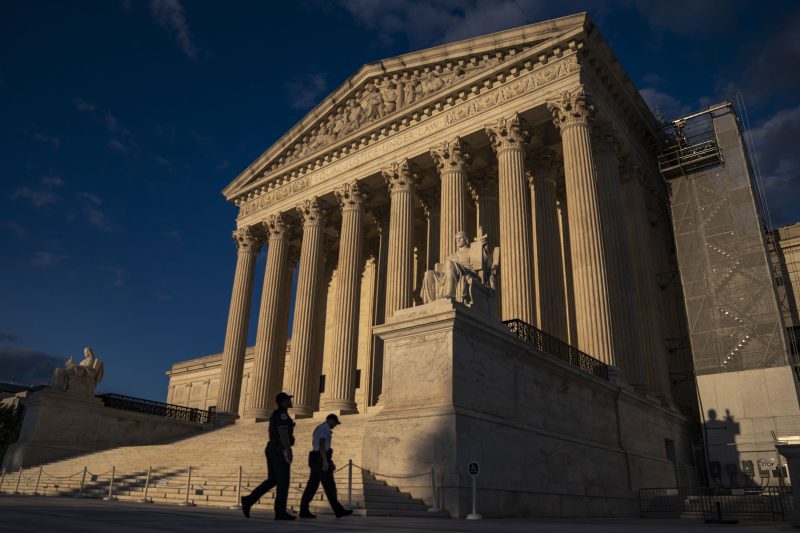
The Supreme Court cleared the way Wednesday for a Biden administration plan to cut greenhouse gases and other emissions from fossil-fuel fired power plants, denying an emergency appeal by more than two dozen Republican-led states, utilities and others.
The groups sought the emergency injunction while they pursue litigation to block the regulations, claiming the Environmental Protection Agencyâ€
The Biden administration said the plan was calibrated to avoid economic harm and problems for the electric grid, and that the rule would protect communities from pollution and help the nation meet long-term goals to combat the climate crisis. The initiative is one of the administrationâ€
It is the third time this month the justices have refused to immediately block a Biden administrative initiative seeking to clean up power plants and oil and gas drilling operations, giving a major — if perhaps temporary — boost to the presidentâ€
As is customary, the majority of the justices did not give a reason as to why they denied the emergency request on carbon emissions from power plants. But a statement attached to the denial order indicates that some justices may be inclined to eventually block or strike down the power plant regulations.
Justice Clarence Thomas said he would have granted the application for a stay, while Justices Brett Kavanaugh joined by Neil M. Gorsuch issued a statement saying the applicants shown a “strong likelihood of success on the merits to at least some of their challenges.’ Kavanaugh and Gorsuch said they voted to deny the stay because the applicants do not need to start compliance work until June of next year.
“Given the that the D.C. Circuit is proceeding with dispatch, it should resolve the case in its current term,� they wrote. “After the D.C. Circuit decides the case, the nonprevailing parties could, if circumstances warrant, seek appropriate relief in this court.�
The high courtâ€
During the term that ended July 1, the court placed on hold an ambitious EPA plan to address smog-forming air pollution that drifts across state lines, which companies and trade associations are challenging in lower courts. The justices also weakened the EPAâ€
The power plant plan that was the focus of the most recent Supreme Court action was finalized in April. It would require all coal-fired power plants that operate past 2039 and new natural gas-fired power plants to reduce carbon emissions by 90 percent.
The EPA estimates the plan by 2047 would reduce carbon emissions by about 1.4 billion metric tons, which is roughly equivalent to the annual emissions of 328 million cars. In a single year, the agency said, the plan could avert 1,200 premature deaths and hundreds of trips to the emergency room.
Critics of the initiative challenged it in the D.C. Circuit Court of Appeals, which denied a stay. The parties then sought an emergency order from the high court.
Environmentalists joined the agency in hailing Wednesdayâ€
“The misguided attempts to block the EPAâ€
EPA spokesman Nick Conger said in a statement that agency officials “look forward to implementing this rule, which is based on proven and cost-effective control technologies, to secure up to $370 billion in climate and public health net benefits over the next two decades.�
Rich Nolan, president and chief executive of the National Mining Association, predicted the rule could cause economic catastrophe.
“While weâ€
Republican presidential nominee Donald Trump said at a campaign stop in Pennsylvania earlier this year that he would eliminate the power plant rule if reelected, saying it was an “anti-American energy crusade.�
The appeals court in the D.C. Circuit found the states and utilities are not likely to succeed on the merits of their case and said the plaintiffs could not demonstrate a need for an emergency injunction because the compliance deadlines for the regulations donâ€
The D.C. Circuit also found the power plant plan did not trigger the “major questions� doctrine that says agencies seeking to decide issues of major national significance must have clear congressional authorization to do so.