
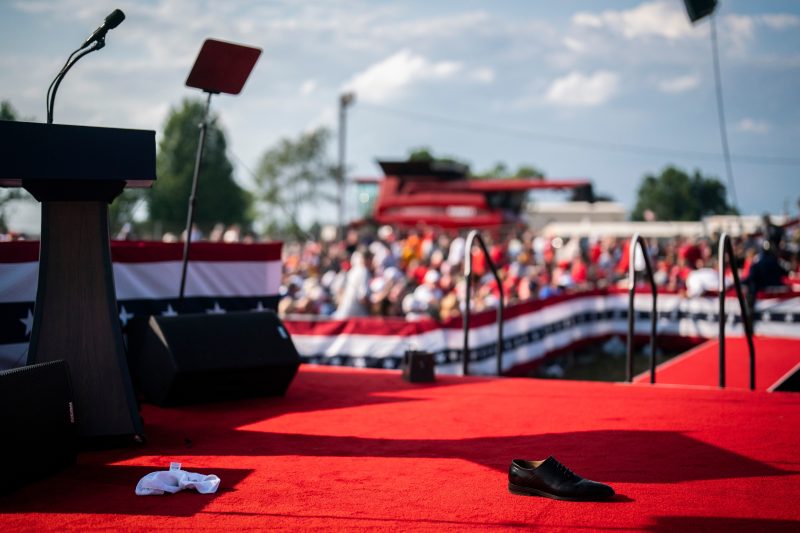
On the first night after Donald Trump was injured in an assassination attempt in Butler, Pa., some supporters and allies, including campaign staff, immediately began blaming President Joe Biden and Democrats before any information was available about the shooter or his possible motive. Trump himself didnâ€

But his tone changed in recent weeks, as the Republican presidential nominee began promoting such conspiracy theories as those that label the assassination attempt an “inside jobâ€� by government agencies or make up Democratic ties to lawyers representing the shooterâ€
“I probably took a bullet to the head because of the things that they say about me,â€� Trump said at Tuesdayâ€
The photo of Trump raising his fist with blood on his face has supplanted his mug shot as the defining image of his campaign, adorning everything from T-shirts to Christmas ornaments, and symbolizing the feeling of defiance that Trump has made core to his political persona. Republicansâ€
His frequent retellings of what happened in Butler serve to deepen his bond with his supporters by fostering a collective experience of overcoming adversity. That shared feeling gets intensified by a perceived indifference from the media and the rest of the country, as attention quickly moved on from the shooting to Trumpâ€
“The more we see what happened that day, the more suspicious it all looks,� right-wing podcast host Monica Crowley said in an interview with Trump released on Aug. 29. “It looks like the three-letter agencies are slow-walking a lot of this evidence, a lot of the videos, etc. Does it look increasingly to you like this was a suspicious, maybe even inside job?�
“Itâ€
Trump campaign senior adviser Brian Hughes said: “President Trump wants to ensure we learn where failures happened and how to prevent them in the future, because the American people, especially Coreyâ€
Researchers who study political violence said these words, images and emotions have the dual effect of mobilizing Trumpâ€
“It is creating a permission structure for at least some people to want to take matters into their own hands,â€� said Matt Dallek, a George Washington University professor who studies the conservative movement and is working on a book about presidential assassination attempts and political violence in the 20th century. “It operates similarly to the ‘big lieâ€
Investigators have yet to identify a motive for the shooter, Thomas Matthew Crooks, 20, who was killed at the scene by a Secret Service sniper. Authorities said Crooksâ€
A series of lapses made it so Crooks was able to take multiple shots at Trump using his fatherâ€
The Secret Service repeatedly turned down the Trump campaignâ€
The shock of freak events like assassinations almost always tempt imaginations, with loose ends about the political murders of the 1960s that linger still today. In the case of the Butler rally, the embarrassing revelations and stubborn unknowns have given Trump and his supporters ample jumping-off points. Some on the left have also engaged with unfounded suspicions about the source and nature of Trumpâ€
“This is all set up to prime his base to believe that, if his loses in November, the Democrats have once again stolen the election, that Harris is illegitimate, and they should in some respects come to his defense,â€� said Barbara F. Walter, a professor at the University of California at San Diego and the author of “How Civil Wars Start and How to Stop Them.â€� If his polls deteriorate in coming weeks and it looks like he may lose, she added, “heâ€
‘Donâ€
The prospect of an assassination was on the minds of some Trump supporters long before the Butler rally. In December 2020, Trump told friends he feared Iran might try to kill him as retaliation for the drone strike he ordered to kill Maj. Gen. Qasem Soleimani, according to the book “The Dividerâ€� by Peter Baker and Susan Glasser. Fans at Trumpâ€
Last year, as Trump stared down four separate criminal cases, he repeatedly passed on invitations to speculate that an assassination attempt could be in his future. “Are you worried that theyâ€
The eventual attempt on Trumpâ€
That week of speeches and meetings quickly developed the accepted meaning of the assassination attempt within the party and movement. The “fightâ€� chant became a constant refrain. Photos of Trumpâ€
“When he stood up after being shot in the face, bloodied, and put his hand up, I thought, at that moment, that was a transformation. This was no longer a man,â€� Carlson said in his speech on the conventionâ€
Trumpâ€
As the speech went on, Trump returned to form, vilifying immigrants and demanding the dismissal of the criminal cases against him. By the end of the month, Trump would acknowledge how short the respite lasted.
“They all said, ‘Trump is going to be a nice man now. He came close to death.â€
‘A lot of coincidencesâ€
Notwithstanding his caveat at the convention, Trump proceeded to recount the shooting again and again. At the July 31 rally in Harrisburg, he marveled that the Butler rally hadnâ€
People in the crowd started shouting, “Heâ€
The person standing to accept to adulation in Harrisburg was not, in fact, the man in the green floppy hat whom Trump had been describing. That man asked not to be identified.
Still, the observation that the rally attendees in Butler stayed and watched Trump rather than flee quickly became a popular feature of the story, usually offered as testament to their courage and dedication to Trump — making the brush with disaster something they survived together.
“The people of Butler County didnâ€
That night, after Trump took off in his plane and police cleared the fairgrounds where the rally had been, someone down the road set off fireworks. People put out Trump signs and banners and spray-painted “FIGHT� on the streets. Hulings remembered driving the next day to show his wife the fairgrounds but it was blocked off by investigators, and he noticed the church parking lots were full.
“Iâ€
An anonymous petition circulating online gathered more than 7,000 signatures to ask the county judge to impanel a grand jury to investigate the assassination attempt, alleging that federal agencies have conflicts of interest and “possible perceived corruption.�
Trump allies and surrogates are already echoing his language or going further. In a Sept. 6 radio interview, Sen. Ron Johnson (R-Wis.) drew a line connecting the JFK assassination, the downfall of President Richard M. Nixon and the Butler shooting.
“Weâ€