
Republican presidential nominee Donald Trump is relying on a cluster of loosely coordinated outside groups to run turnout operations traditionally performed by the campaign itself, an approach that takes advantage of new leniencies in campaign finance rules but comes with the risk of untested outfits duplicating efforts or working at cross purposes.
With fewer than 100 days left before the election, local GOP officials in battleground states have raised alarms about the scant presence of Trump campaign field staff. For the large armies of paid and volunteer door-knockers and canvassers that typically drive turnout in presidential elections, the campaign is largely relying on outside groups such as America First Works, America PAC and Turning Point Action.
The Trump campaignâ€

Past experiments with outsourcing field operations, most notably Florida Gov. Ron DeSantisâ€
In what everyone expects to be a close election, the unglamorous mechanics of mobilizing a sliver of additional voters can make all the difference. In 2020, a change of about 43,000 votes across Arizona, Georgia and Wisconsin would have been enough to tip the electoral college.
In March, the Federal Election Commission issued new guidance that opened the door for campaigns and outside groups to collaborate on turnout efforts. In the past, campaigns and official party committees, which are subject to contribution limits, generally observed a firewall that blocked information-sharing with super PACs and nonprofits that accept unlimited contributions.
Now, campaigns and outside groups are free to share messaging and exchange data. That new opportunity has allowed the Trump campaign to supplement a bare-bones in-house field program with allied programs fueled by megadonors.
“These folks have been pre-dividing themselves based on their own focuses,â€� said a Trump campaign official who wasnâ€
Before the Trump campaignâ€
The documents show a Trump operation that was once prepared to spend extensively across the country, targeting particular communities and attempting to reach more than 1 million voters. In many of the states, the plans included certain towns, small subsections of the population or demographics where the campaign had underperformed in the past.
“While the Trump Victory Team on the ground did an excellent job getting out the vote in 2020 on Election Day, we did not turn out enough of low propensity voters to compete with the Democrats in early voting or persuade enough voters to hit the number of votes we needed to win,� the Pennsylvania plan said. “We need to learn from the lessons of 2020,� it added.
“They were totally discarded,� said a person familiar with the plans, who like others spoke on the condition of anonymity to describe private matters.
The campaignâ€
Volunteers who meet their goal of recruiting 10 voters receive larger lists of targets, focusing on infrequent voters and people who arenâ€
The Trump campaign declined to disclose how many volunteers it has recruited. “The Trump Force 47 program prioritizes many volunteers doing a few high-impact tasks each instead of old models which devolved to few volunteers trying to do many low-impact tasks each,� said political director James Blair.
By contrast, the Harris campaign and allied outside groups said they are not changing their approach in response to the FEC decision. The campaign said it has 1,300 staff members (including party payrolls) and 250 offices in battleground states organizing events, trainings, door-knocking, phone calls and online peer messaging. It recruited 170,000 new volunteers who signed up since President Biden withdrew in late July and held 2,300 events in swing states last weekend to mark 100 days to the election.
“Our campaign will make millions of voter contacts after having millions of conversations with voters in battleground states with thousands of staff, tens of thousands of volunteers and hundreds of thousands of events,â€� said the Harris campaignâ€
‘Rolling up to the house thatâ€
More than 50 conservative groups met in Washington in April to coordinate efforts, including avoiding redundancy in voter outreach. The coalition continues to meet on a weekly basis.
“Everyone sees the marketplace here,â€� said a prominent Republican involved in one of the efforts. “Everyone sees the campaign isnâ€
America First Works, a nonprofit affiliated with the America First Policy Institute that employs many Trump administration alumni, convened the summit, and is itself focusing this year on door-to-door canvassing with paid door knockers and volunteers in 19 bellwether counties such as Bucks County, Pa., Maricopa County, Ariz., and other suburban counties with populations of 400,000 or more. The group said it has fanned people out to knock on 500,000 doors since June.
One of the most ambitious upstart efforts comes from Turning Point Action, the five-year-old political organization founded by right-wing activist and podcaster Charlie Kirk. Kirkâ€
Turning Point Action, which has also amplified Trumpâ€
Bowyer and Kirk set out to raise about $100 million and hire hundreds of local full-time organizers in the critical battleground states of Arizona, Wisconsin and Michigan, aiming to build a permanent campaign infrastructure on par with what Democratic-aligned groups have developed in recent decades. Bowyer said the group studied social science research and public documents from Democratic-aligned groups to assess successful techniques that they could replicate.
“I truly donâ€
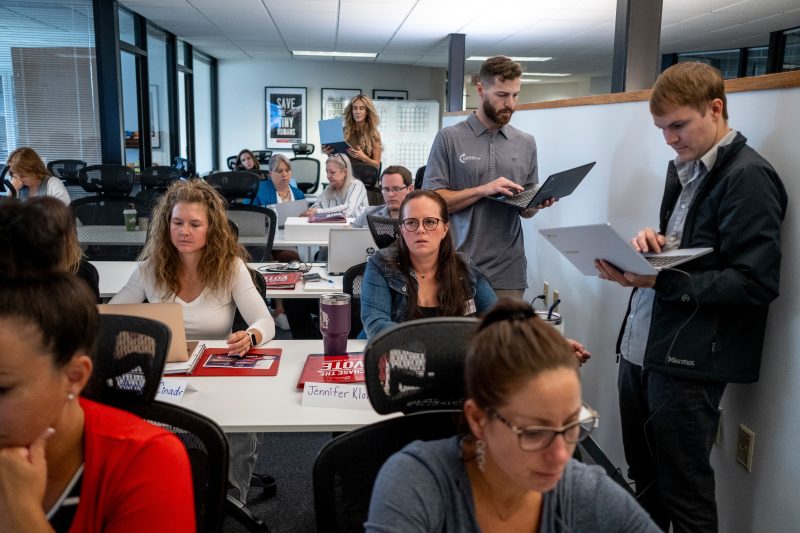
At a Turning Point Action office in Waukesha, Wis., in June, about three dozen newly hired full-time community organizers got together with poster boards and scented markers to brainstorm techniques to meet their targeted neighbors. They were each assigned a few hundred registered Republicans who didnâ€
Bowyer instructed the organizers not to come on too strong by showing up with MAGA hats and fliers. Instead, they should research their marks and start reaching out through Facebook groups, community events, or neighborly gestures such as recommending plumbers or harp teachers. They could even arrange seemingly chance encounters on coffee runs or dog walks.
“Some of these things sound like stalking,� one staffer whispered.
“Professional stalkers,� his colleague joked back.
As one slide from the training implored: “BE NORMAL. BE NORMAL. BE NORMAL.�
Turning Point Actionâ€
A constellation of groups
Other conservative groups are also engaged in ground efforts. The Faith and Freedom Coalition will focus on evangelical voters and expects to spend $62 million to send 10,000 staffers and volunteers to knock on 10 million doors in presidential and Senate battleground states and 42 House districts, according to the Christian conservative groupâ€
The Trump campaign official said more outside groups would emerge to participate in various facets of Trumpâ€
The outfit is focused on the seven core battleground states of Pennsylvania, Michigan, Wisconsin, North Carolina, Georgia, Arizona and Nevada. The program is being run by former Republican Governors Association director David Rexrode, as well as Generra Peck and Phil Cox, alumni of DeSantisâ€
The Musk-backed program is in flux, a person familiar with the operation said, after it cut ties with a firm that had been hired to handle much of the operation. It is unclear what the group will do next.
One person familiar with Trumpâ€
In Pennsylvania, a former teacher and onetime Ron Paul supporter is assembling a door-knocking program called Pennsylvania Chase with the sole purpose of getting Trump supporters to request mail ballots and return them. Cliff Maloney said his plan is inspired by the fact that in 2020, roughly 140,000 Republicans requested mail ballots and never turned them in, and Biden won the state by about 80,000 votes. (It was not clear how many of those Republicans voted in person.)
“No one went to their door and said: ‘Hey Bob, you got that little ballot sitting there? Letâ€