There is not a lot of complexity to the ongoing war in Ukraine. In early 2022, Russian President Vladimir Putin amassed tanks and troops at the nationâ€s eastern and northern borders. He created a pretense under which he might present his country as protecting separatists operating in a portion of Ukraine occupied by Russia eight years prior. And then he swept in, aiming to quickly subjugate the Western-allied nation and its president, Volodymyr Zelensky.
It didnâ€t prove to be that easy. Ukrainian forces, with support from the United States and other European allies, were able to disrupt and then stall Russiaâ€s invasion. For more than two years now, the conflict has been at a near-impasse, with Russia holding an expanded segment of eastern Ukraine but little more.
For many Americans and many in the U.S. government, Putinâ€s initial failure was a remarkable success. Here was an allied, democratic nation fending off — at least for now — an authoritarian regime bent on Ukraineâ€s subjugation. But asked to pick between autocracy and democracy — and particularly when asked to pick between Putin and a traditional American ally — Donald Trump chose Russia.
He immediately embraced Putinâ€s conceit that the separatists needed Russian protection, calling it “geniusâ€� and “smart.â€� He figured that it was “very smartâ€� for Putin to annex an entire country for the price of “$2 worth of sanctions.â€� And then, as Putinâ€s genius invasion ground to a halt, Trump soon began elevating skepticism about Ukraineâ€s odds of success and the utility of continuing to back the effort. This argument trickled out into the broader MAGAverse.
The conflict is ongoing. And speaking to a podcaster this week, Trump identified the culprit: Zelensky.
“Itâ€s so bad what theyâ€re doing with the money,â€� Trump said, referring to the Biden administration and what Trump presents as profligate spending. “The billions and billions of dollars. I think Zelensky is one of the greatest salesmen Iâ€ve ever seen. Every time he comes in, we give him $100 billion. Who else got that kind of money in history? Thereâ€s never been.â€�
“And that doesnâ€t mean I donâ€t want to help him because I feel very badly for those people,â€� he continued. “But he should never have let that war start. That warâ€s a loser.â€�
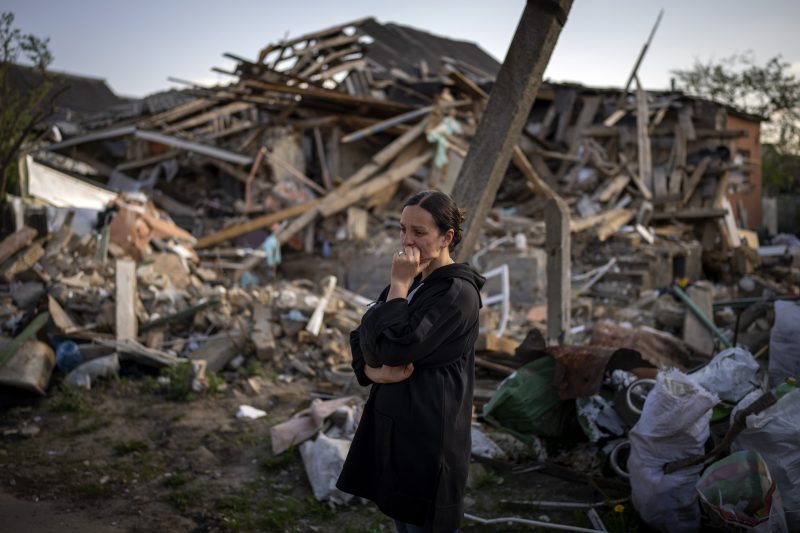
Trump noted that the country had been tremendously damaged by the conflict — a conflict that, again, was a function of Russian aggression.
“This should have been settled before it started,� he insisted. “It would have been so easy if we had a president with half a brain, it would have been easy to settle.� At another point in the interview, he claimed not for the first time that, should he win the presidency in November, he would quickly and easily bring the war to an end.
The response to Trumpâ€s latest comments have understandably focused on his assertion that Zelensky “should never have let that war start.â€� Even in the context of Trumpâ€s long-standing obsequiousness to Putin, itâ€s hard to understand how Zelensky would have prevented having his nation be invaded. He could, in theory, have taken the approach that many Trump allies have since endorsed: simply agreeing to cede some or all of Ukraine to Russia, a move that would have prevented the damage incurred to the countryâ€s buildings but amplified the damage done to its sovereignty.
It is generally understood that Trumpâ€s promises to bring the war to a rapid end would likely mirror this approach. Were the United States to withhold aid to Ukraine to afford Trump a political victory — a phrase which might sound familiar from his 2019 impeachment — the result would presumably be a capitulation on Zelenskyâ€s part in favor of Putin. The United States doesnâ€t have leverage over Russia beyond the threat of our directly engaging in the conflict, something no president would threaten — particularly if that president were Donald Trump. We do have leverage over Zelensky, which a president could threaten — particularly if that president were Donald Trump.
Trumpâ€s suggestion that itâ€s somehow Zelenskyâ€s fault that his country was targeted by Russia has some familiar undertones. It is the case that the weaker kid could have avoided being beaten by the bully, for example; the weaker kid simply needed to hand over the dollar as requested. There are any number of other examples of blaming victims of assault for being victimized, of course, like that the victims are simply awestruck at being in the presence of a celebrity. The subtext of abuse and the excuses of abusers here are unavoidable.
We donâ€t know how often Trump and Putin have spoken since the full-scale invasion got underway in 2022. Itâ€s likely that it has been at least a half-dozen times, according to reporting from The Washington Postâ€s Bob Woodward. It seems very possible that, given Trumpâ€s ear, Putin might have offered up the sort of history-adjacent rationalization that he has presented elsewhere, including to Trumpâ€s ally Tucker Carlson.
Donald Trump once emerged from a meeting with Putin and declared to the world that he equated Putinâ€s word about Russiaâ€s 2016 election interference with that of Americaâ€s intelligence officials. Itâ€s not a stretch to think that Trump might similarly accept an assertion from Putin that Zelensky forced him to invade against his will.
At other points since the invasion, Trump has insisted that Putin would never have invaded had Trump remained president. He claims to have had conversations in which Putin indicated that Ukraine was “the apple of his eye,â€� to use Trumpâ€s phrasing, but Trump told him hands off. So Putin kept his hands off — until Joe Biden was president and … Ukraine let Russia invade?
None of this makes sense unless we view this not through the lens of geopolitics but through the lens of Trump. To Trump, the powerful do what they want and the less-powerful are expected to acquiesce. No more, no less. So it is with Ukraine. So it is with everyone else.
Extremist supporters of former president Donald Trump are lashing out online against Usha Vance, the wife of Trumpâ€s running mate, Sen. J.D. Vance (R-Ohio),...
Australia is home to a thriving tech sector with investment opportunities across a variety of subsectors. The tech sector contributed about AU$167 billion to...
Sister Stephanie Schmidt had a hunch about what her fellow nuns would discuss over dinner at their Erie, Pennsylvania, monastery on Wednesday night. The...