
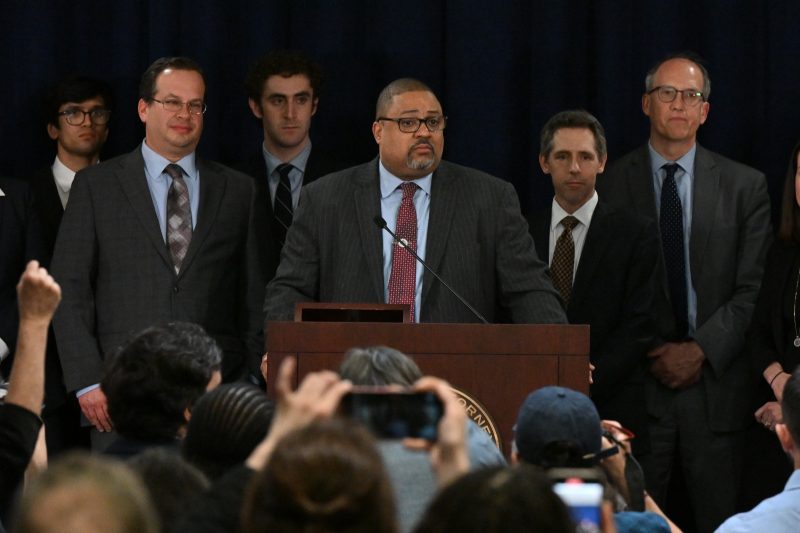
NEW YORK — Alvin Bragg watched his place in the history books take shape from the second row of the courtroom Thursday, as a jury foreman rose from his seat and confidently announced each of 34 findings of guilt against Donald Trump.
Bragg (D), the elected Manhattan district attorney, had weathered a tide of criticism for bringing charges against the former president for allegedly falsifying business records related to a hush money payment ahead of the 2016 election.
Some thought the case was weak. Others — namely the defendant and his allies — continue to insist without offering evidence that it was a politically motivated attack on Trump, the presumptive Republican nominee in this yearâ€

Those who know Bragg say he approached the prosecution the way he approaches most cases: quietly and businesslike. He was undeterred by the constant political attacks, they say, and committed to pursuing a novel legal theory that he believed made sense.
“Our job is to follow the facts and the law without fear or favor. And thatâ€
Some elected officials might have taken the opportunity to declare vindication. Bragg gave credit to his trial team, the jury, police and the court system that managed the unprecedented challenge of hosting the first-of-its kind trial, expressing “gratitude to work alongside phenomenal public servants.�
Bragg, who declined to speak for this article, also nodded to the legacy of the Manhattan district attorneyâ€
The indictment Bragg filed last spring marked the first time a former U.S. president had faced criminal charges. It was the first of four criminal indictments that would plague Trump as he again sought his partyâ€
Trump was convicted in New York of engaging in a scheme to conceal the true nature of a $130,000 payoff to adult-film actress Stormy Daniels ahead of the 2016 election to keep her quiet about an alleged sexual encounter with Trump years earlier. The jury found that Trump falsely classified his reimbursement to his then-attorney, Michael Cohen, to protect his chances at winning.
Jim Walden, a former federal prosecutor now in private practice, said Bragg “handled this case beautifully despite the intense public scrutiny over every move� — staying restrained and focusing on the jury, rather than himself, when it was over.
Like other law enforcement figures who have taken on Trump, Bragg, who is the first Black district attorney in Manhattan, has been inundated with race-based hate messages and threats of violence. Last year, investigators fielded almost 600 threats against Bragg, his family or his staff.
New York Attorney General Letitia James (D), who successfully sued Trump and his namesake company for engaging in a decade of fraud, has also been a target of Trump and his supporters, with racist and sexist rants.
Instead of responding to the incessant attacks, Bragg stayed quiet and did his job, keeping his responses limited to what his team presented in court.
“I donâ€
A native of Harlem and a graduate of Harvard University and Harvard Law School, Bragg is seen in New Yorkâ€
Bragg “stayed the course and he was very quiet about it … He was about the business of prosecuting the case that he thought should be prosecuted,â€� said Donaldson, now a defense attorney in private practice. “You donâ€
Trump-aligned Republicans such as Rep. Jim Jordan (R-Ohio) have tried to drag Bragg into blatant political sideshows. This month, Jordan is seeking Braggâ€
In what was widely seen as a partisan stunt, Jordan convened a committee hearing on public safety in New York shortly after Bragg indicted Trump, an effort to paint the district attorney as an inadequate crime-fighter whose policies were amplifying a sense of dangerousness in the city.
Since beginning his four-year term in 2022, Bragg has faced an onslaught of disapproval from police unions and residents who say his crime-fighting policies are too lenient.
Braggâ€
In choosing to bring the hush money case against Trump, Bragg was breaking with his former colleagues at the Manhattan U.S. attorneyâ€
Cohen pleaded guilty in 2018 to violating campaign finance law on the basis that the hush money benefited Trumpâ€
Federal prosecutors could not have charged Trump in 2018 because of Justice Department prohibitions on charging a sitting president. Once Trump was out of office, they concluded a case against him was too risky because it would rely heavily on the word of Cohen, by then a disbarred attorney and felon, people familiar with the matter have told The Washington Post.
Braggâ€
During the trial, prosecutors walked jurors through the a complicated theory of the case that required them to agree that Trump falsified the records in an effort to affect the 2016 election, and that it was reasonable to conclude that he violated one of three state laws while doing so.
In less than two full days of deliberations after weeks of testimony, the jury found Braggâ€
Devlin Barrett contributed to this report.