

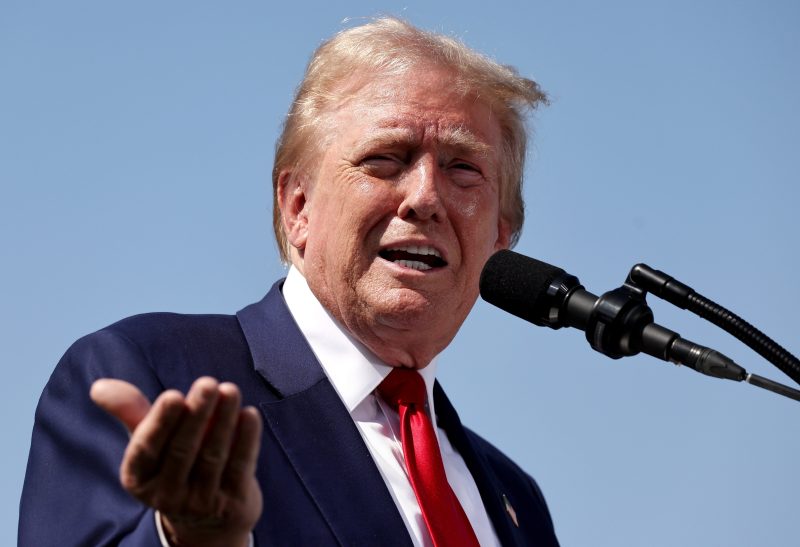
For days, Donald Trump and his allies have zeroed in on Springfield, Ohio, amplifying baseless claims that Haitian immigrants there are eating othersâ€
“Weâ€
His remarks were the latest in a swirl of canards that Trump has spread about Haitian immigrants, despite local officials debunking the claims. Leaders in Springfield have said the claims are harming the community, which has been forced to evacuate schools, city hall and other buildings after receiving threats since Trumpâ€
Trump first mentioned Springfield while debating Vice President Kamala Harris on Tuesday night, saying: “In Springfield, theyâ€
Trump has also incorrectly said that Haitians in Springfield are in the U.S. illegally, though local officials have rebutted that as well. The migrants were granted temporary protected status in the United States after fleeing violence at home.
The claims are the latest instances of Trump using dehumanizing language when talking about people who immigrate to the United States. They also mirror stereotypes some Americans have used against foreigners in the United States for nearly a century and a half.
Since the first wave of Chinese immigrants arrived in the 1800s, they — along with others from European, Asian or Latin American nations — have been the subject of political cartoons, newspaper articles, caricatures and books that were used by some in politics and media to spread anti-immigrant rhetoric and instill fear in other residents, experts said.
“My first thought was: Here we go again,â€� said Anita Mannur, director of American Universityâ€
Immigration and border security has been a flash point leading up to the November election. Republicans have singled out Springfield, which has seen an influx of Haitian immigrants in recent years after a boom in manufacturing jobs attracted new residents. The Haitian immigrants, Springfieldâ€
Yet the sudden arrival of people has stretched schools, health clinics and other public services. Tensions soared in Springfield last summer when a Haitian immigrant drove into oncoming traffic and hit a school bus, killing Aiden Clark, an 11-year-old boy. His parents this week pleaded that their sonâ€
“To clear the air, my son, Aiden Clark, was not murdered,� Nathan Clark said Tuesday during a public meeting in Springfield. “He was accidentally killed by an immigrant from Haiti.�
Trump repeating the rumor about Springfield residentsâ€
Such leaders win support by creating fear about certain groups, then portraying themselves as the only person who can address the problems they cause, said Florida International University law professor Ediberto Román, who studies xenophobia and immigration.
In response to questions from The Washington Post, Trump campaign spokeswoman Karoline Leavitt said people in Springfield were experiencing “very real suffering and tragediesâ€� that have been “largely ignored by the liberal mainstream media until now.â€� A spokesman for Vance did not respond to requests for comment; earlier, a spokesperson told The Post that Vanceâ€
Stereotypes about immigrants eating dogs, bats or rats have long circulated in the United States — beginning during the wave of Chinese migration in the 1800s. More recently, during the 2012 presidential election, conservatives briefly seized on a passage in President Barack Obamaâ€
The goal in spreading such stereotypes is to portray newcomers as unfit for American society or invoke disgust toward them, Mannur and other experts said.
“One of the ways to vilify Asian Americans was to cast them as ‘otherâ€
“So thatâ€
People around the world have long consumed wide-ranging cuisines, sometimes depending on the varying sources of available protein. But those differences can be weaponized to sow division and propel the notion that some immigrants are incapable of assimilating “because theyâ€
That can fuel nativism, or the idea that immigrants present an existential threat, she said.
“The most successful claims for politicians trying to demonize immigrants have to have a tiny kernel of truth in them, or something that might make them easier to believe,â€� Young said. “So, for instance, in the case of Haitians: Most people in the U.S. know nothing about Haiti, but they might know that itâ€
Haitians have a long history of immigrating to the United States and as of 2022, most of the 700,000-plus Haitian immigrants in the United States had already become U.S. citizens, according to the Migration Policy Institute, a think tank. But the number of newer arrivals seeking to enter the country has jumped in recent years. Many are fleeing gang and political violence in Haiti. Some had earlier moved to South America and are coming directly from there.
The number of Haitians crossing the southern border illegally has dropped from approximately 45,000 in fiscal year 2021 to more than 1,000 last year, according to Border Patrol data. Officials attribute the decline to a new Biden administration parole program that has allowed Haitians and others to enter legally at airports if they have a U.S. sponsor and prior approval. Approximately 200,000 Haitians have arrived legally under that program since 2023, federal records show.
For Haitians in the U.S. and abroad, the episode has prompted anger and sadness. Farah Juste, an activist and singer who lives in Florida, said sheâ€
Still, anti-immigration sentiments, or nativism, has been part of American politics since the countryâ€
Luke Ritter, a historian who has extensively researched nativism and American conspiratorial beliefs, echoed Young: “Nativism in the U.S. rises and falls across time like the waves of the ocean. Each time nativist rhetoric increases, it takes on a slightly different shape and color, but it draws from the same well of anxiety.�
Trump seizes on those anxieties by blaming immigrants for problems in American society, Young said.
Immigration limits are core parts of Trumpâ€
Since he entered politics, Trump has disparaged immigrants in inflammatory and sometimes racist language. He launched his 2016 presidential campaign with a speech in which he told supporters that Mexico was sending rapists, drugs and crime into the United States. He has called immigrants animals, thugs and terrorists, dismissed them as carriers of disease and portrayed Latino migrants as staging an “invasion� of the United States. Last year, he said undocumented immigrants are “poisoning the blood of our country,� drawing criticism from experts who compared his language to that of Adolf Hitler.
Trump has also turned his rhetoric toward Haitians in the past: In 2018, he called Haiti and other nations “shithole countries.� In 2017, the New York Times reported he said immigrants from Haiti “all have AIDS.� In 2021, he repeated the idea on Fox News, saying there are “hundreds of thousands of people flowing in from Haiti� and that many of them “probably have AIDS.�
Tony Jean Thenor, a 66-year-old social worker from North Miami who emigrated from Haiti in 1980, said Trumpâ€
“Itâ€
Widlore Mérancourt, Maria Sacchetti, Mariana Alfaro, Azi Paybarah and Amy B Wang contributed to this report.