
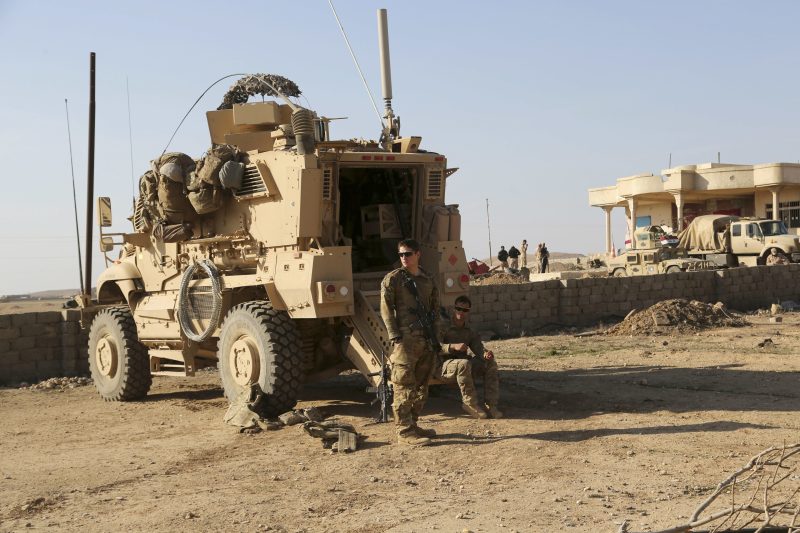
U.S. officials on Friday said they have agreed to a two-stage shift in the American military presence in Iraq that will allow for continued operations against Islamic State militants in Syria, but pointedly disputed Baghdadâ€

The announcement, coming two weeks after the Iraqi government said it had reached a deal with the Biden administration to remove most U.S. troops over the next two years, underscored Washingtonâ€
There are 2,500 American personnel in Iraq now. Iraqi officials have said that once the drawdown is complete, a small residual force would remain in northern Iraq to act as a bulwark against the Iranian-backed militia groups that hold wide sway in the rest of the country. Speaking to reporters Friday, officials from the State Department and Defense Department declined to confirm those plans, alluding instead to the U.S. governmentâ€
“Iâ€
The official told reporters there “could very well be� changes in the number of U.S. troops in Iraq but declined to elaborate. U.S. and Iraqi discussions are ongoing, the official said.
A Pentagon spokeswoman, Sabrina Singh, said during a separate briefing Friday “itâ€
U.S. officials did affirm that the first phase of this “evolution� will end the current military mission in Iraq by September 2025. Baghdad and Washington also have “reached an understanding� in which the roughly 900 U.S. forces deployed to neighboring Syria will continue to receive support from the Iraqi side of the border through at least September 2026, the senior administration official said.
The Iraqi government did not immediately respond to a request for comment on the U.S. governmentâ€
The announcementâ€
Since the eruption of renewed conflict between Israel and Hamas militants in the Gaza Strip a year ago, U.S. positions in Iraq, Syria and Jordan have come under extensive attacks by Iranian-backed militias. Three U.S. troops were killed by a one-way attack drone in January at a U.S. base in Jordan supporting operations in Syria. American forces have conducted periodic airstrikes in response, most recently in July near Baghdad, drawing intense blowback from the Iraqi public.
American troops also continue to conduct periodic operations against remaining Islamic State militants. Last month, seven U.S. troops were wounded doing so in western Iraq.
The counter-ISIS mission, now a decade old, remains a priority, officials say. The Obama administration, which had removed all U.S. troops from Iraq in 2011, launched a comprehensive air war against the militants over the next few years and deployed thousands of U.S. forces on the ground to assist Iraqi forces as they took back territory.
Kurdish forces in neighboring Syria maintain the detention centers housing thousands of captured militants and occasionally targeted by the groupâ€
Both countries continue to face threats from the Islamic State, a reality highlighted by the joint raid in August that killed at least 14 militants. U.S. military officials said then that the ISIS fighters were heavily armed and seemingly prepared for a fight.
A senior defense official, speaking on the call with reporters Friday, said the United States retains its right to self-defense and has demonstrated that “we will not hesitate to take all appropriate action to protect our personnel.� Those principles will continue to apply, the official said, as this shift in mission occurs.
Missy Ryan contributed to this report.