

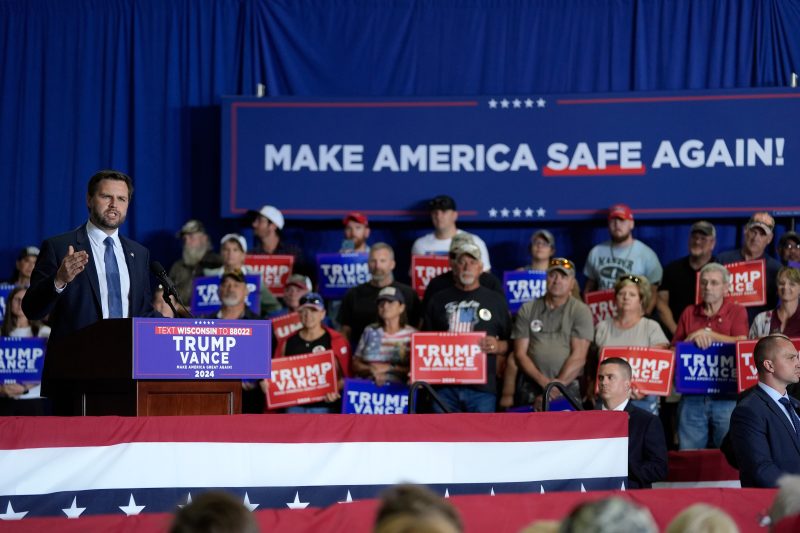
Sen. JD Vance (R-Ohio) has been on the defensive for more than a week after repeating baseless claims that immigrants living in a small Ohio city were stealing and eating local animals. His efforts to pivot the story into one thatâ€
One way in which the Republican vice-presidential nominee has consistently attempted to rationalize his claims is by leveraging his position as the stateâ€
“Why have I talked about some of the things that I have been talking about?â€� Vance said in response to a question posed on CNN on Sunday. “Let me just say this: My constituents have brought approximately a dozen separate concerns to me. Ten of them are verifiable and confirmable, and a couple of them I talk about because my constituents are telling me firsthand that theyâ€
It should not escape notice that there is a difference between “verifiable� and “verified,� between “confirmable� and “confirmed.�
The implication is that he is privy to nonpublic information that informs his views. You can see how this is useful: He can claim that he knows more than his interlocutor. But thereâ€
Consider his initial social media post about the rumors centered on Springfield. It came the morning of Sept. 9, as the right-wing conversation was giddily promoting unsourced or misconstrued snippets aimed at suggesting that immigrants from Haiti were stealing pet cats and hunting local geese.
Vance noted that heâ€
There were no such “reportsâ€� beyond the claims circulating on the internet. One was a fourth-hand report on Facebook of a stolen cat that was no more than a rumor. Another focused on a photo of a random Black man in a different city. A third looped in a story about an American woman eating a cat in a different part of the state. But notice what Vance doesnâ€
Never mind that those constituent reports would themselves be worth some skepticism. Rumors about immigrants stealing pets — a long-standing racist and anti-immigrant trope — were already circulating, leading to things like that Facebook post or comments presented at public meetings (clips of which also made the rounds). At the outset, though, Vance didnâ€
As it turns out, his office soon knew better. The Wall Street Journal reported on Wednesday that a Vance staffer called Springfieldâ€
On CNN, he pointed to other purported evidence in lieu of the “verifiableâ€� information heâ€
“I was told … by the American media that it was baseless that migrants were capturing the geese from the local park pond and eating them,� he said. “And yet there are 911 calls from well before this ever became a viral sensation of people complaining about that exact thing happening.�
The county had denied days prior that there was evidence of this happening, as had the state Department of Natural Resources. The report Vance cited was elevated by a right-wing, pro-Trump site that was part of an effort to backfill Vanceâ€
In another Sunday interview on NBC, Vance again insisted that his source was his constituents.
“Iâ€
NBCâ€
“Yesterday,� Vance continued, “a video came out of a migrant 30 miles away eating a cat. Clearly, these rumors are out there because constituents are seeing it with their own eyes and some of them are talking about it.�
Well, no. That rumor was out there because right-wing activist Christopher Rufo offered a bounty for evidence that Vanceâ€
The Wall Street Journalâ€
“A Vance spokesperson on Tuesday provided The Wall Street Journal with a police report in which a resident had claimed her pet might have been taken by Haitian neighbors,â€� the report from Kris Maher, Valerie Bauerlein and Tawnell D. Hobbs read. “But when a reporter went to Anna Kilgoreâ€
Kilgore told the reporters that sheâ€
Early Tuesday afternoon, just such a police report had been promoted by a social media account run by the Heritage Foundation, the group that put together the compendium of policy recommendations titled “Project 2025.â€� Dated in late August — after rumors about pet-eating had begun to swirl in the community — the details comport with Kilgoreâ€
The pattern is consistent: Vance insists that his public concerns are driven by what he hears from constituents, but the evidence that the concerns are valid relies on misinformation or unverified reports circulating within the right-wing conversational bubble.