
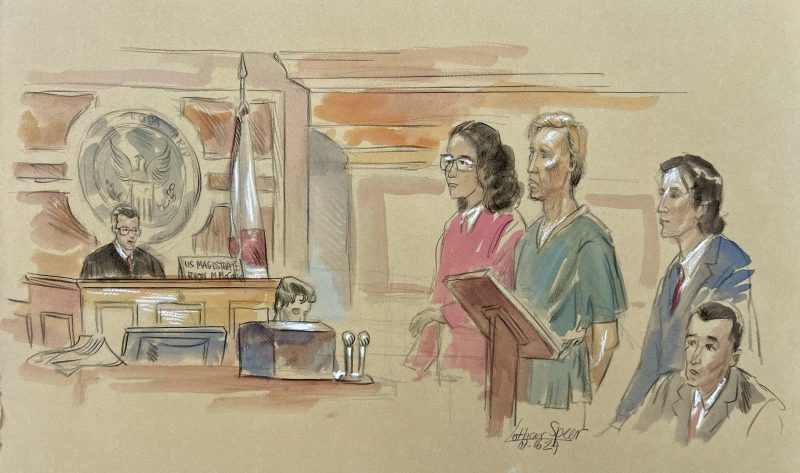
When right-wing conspiracy theorist David DePape broke into the house of Rep. Nancy Pelosi (D-Calif.) in San Francisco, beating her husband, Paul, with a hammer as part of a deranged effort to undermine the investigation into Russian interference in the 2016 election, the initial response from the political right was dismissive. Conspiracy theories abounded, many intended to disparage the victim more than the attacker. As the facts became more concrete, Republicans dismissed DePapeâ€

When Ryan Routh was arrested for attempting to kill Donald Trump, the reaction on the right was very different. Unlike the shooter in Butler, Pa., who grazed Trump with a bullet in July, Routh had publicly expressed hostility to Trump on social media and used language — describing Trump as a threat to democracy — that mirrored rhetoric used by Democratic politicians. While Routh had previously voted for Trump and was not registered with any political party, Republicans saw politics as inextricably linked to his attempt on Trumpâ€
We can see this in polling conducted by NBC News. The media outlet has asked Americans to evaluate several acts of political violence over the past 13 years, from the shooting of Rep. Gabrielle Giffords (D-Ariz.) in 2011 to the attack on Rep. Steve Scalise (R-La.) and other Republican legislators in 2017 to DePape and Routh.
Over time, Americans have been more likely to attribute the cause of the violence (and attempted violence) to rhetoric used by “some in the media� and “political leaders.� Less than a quarter of America cited this as a cause in the Giffords shooting. A majority cited it in the Routh incident.
The increase is in large part thanks to partisans identifying rhetoric as a trigger for the actions. When Giffords was shot, majorities of both Democrats and Republicans identified a disturbed individual as the primary cause. When Scalise was shot, most Republicans blamed rhetoric. When Pelosi was attacked, nearly three-quarters of Democrats pointed at rhetoric. And after Routh was arrested, more than three-quarters of Republicans identified extreme rhetoric as the primary factor.
Itâ€
Trump has a potent interest in pointing at rhetoric as a cause and, as a result, has been uninhibited in doing so. Democratic warnings about the threat Trump poses to democracy — warnings based on Trumpâ€
He also has a reason to keep talking about the twin attempts on his life: It reinforces his supportersâ€
On Monday, CNN reported on research exploring what Americans had heard about the candidates over a period in late September. The presidential debate on Sept. 10 was followed by Routhâ€
There are two, non-mutually-exclusive ways to interpret the divide between Republicans and Democrats here. The first is that Republicans heard more about the assassination attempt. The second is that they heard less about the presidential debate.
A review of mentions of both issues on cable-news broadcasts suggests that both likely occurred. There were 50 percent more mentions of “assassinationâ€� on Fox News (Republicansâ€
Trump and his allies are probably driving a lot of the awareness, too. On Capitol Hill, Republicans have pushed for probes into the assassination attempts that keep the issue in the news. On social media, Republicans offer vague criticisms of the media for not talking more about the assassination attempts. And Trump, particularly in interviews, uses the them as a way to reinforce how much he is disliked by the people his base dislikes.
The former president has also leaned into explicitly religious language in a way that he had not previously. He has never been particularly religious and, during the 2016 campaign, rarely mentioned God in speeches or on social media. This year, though, he has become much more overt in expressing religiosity, a habit that comports with the strong support he enjoys from religious conservatives.
In 2016 and 2020, that support largely came from White evangelical Protestants. Sen. JD Vance (R-Ohio), Trumpâ€
But it is in keeping with the response to the attempts on his life and his campaign in general. He has been seeking reelection to the presidency by portraying himself as a victim of the broader left. In recent months, that has been reframed more explicitly as a battle between good (him) and evil (his opponents). His supportersâ€