
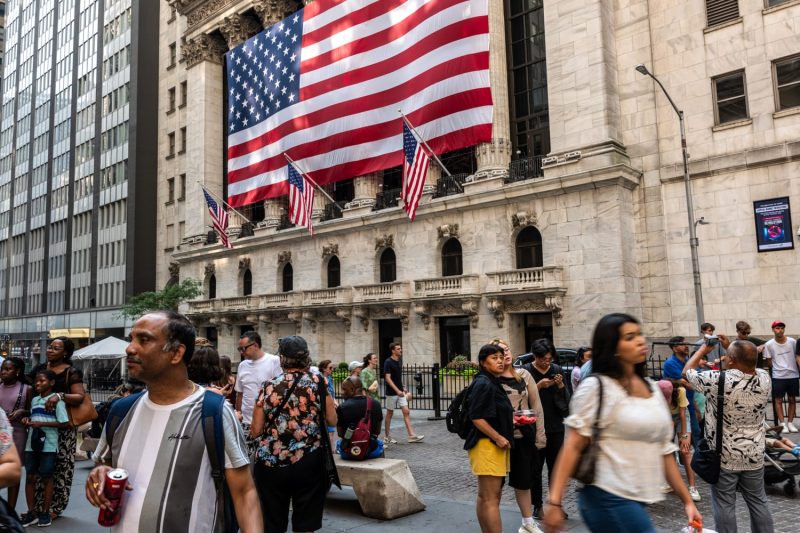
Wall Streetâ€

The yield on the 10-year Treasury note has been lower than most of its shorter-dated counterparts since that time — a phenomenon known as an inverted yield curve which has preceded nearly every recession going back to the 1950s.
However, while conventional thinking holds that a downturn is supposed to occur within a year, or at most two years, of an inverted curve, not only did one not occur but thereâ€
The situation has many on Wall Street scratching their heads about why the inverted curve — both a signal and, in some respects, a cause of recessions — has been so wrong this time, and whether itâ€
“So far, yeah, itâ€
Depending on which duration point you think is most relevant, the curve has been inverted either since July 2022, as gauged against the 2-year yield, or October of the same year, as measured against the 3-month note. Some even prefer to use the federal funds rate, which banks charge each other for overnight lending. That would take the inversion to November 2022.
Whichever point you pick, a recession should have arrived by now. The inversion had been wrong only once, in the mid-1960s, and has foretold every retrenchment since.
According to the New York Federal Reserve, which uses the 10-year/3-month curve, a recession should happen about 12 months later. In fact, the central bank still assigns about a 56% probability of a recession by June 2025 as indicated by the current gap.
“Itâ€
Making the situation even more complicated is that the yield curve isnâ€
Gross domestic product, a tally of all the goods and services produced across the sprawling U.S. economy, has averaged about 2.7% annualized real quarterly growth since the third quarter of 2022, a fairly robust pace well above what is considered trend gains of around 2%.
Prior to that, GDP was negative for two straight quarters, meeting a technical definition though few expect the National Bureau of Economic Research to declare an official recession.
The Commerce Department on Thursday is expected to report that GDP accelerated 2.1% in the second quarter of 2024.
However, economists have been watching several negative trends.
The so-called Sahm Rule, a fail-safe gauge that posits that recessions happen when the unemployment rate averaged across three months is half a percentage point higher than its 12-month low, is close to being triggered. On top of that, money supply has been on a steady downward trajectory since peaking in April 2022, and the Conference Boardâ€
“So many of these measures are being questioned,â€� said Quincy Krosby, chief global strategist at LPL Financial. “At some point, weâ€
Yet no recession has appeared on the horizon.
“Weâ€
Paulsen, who now writes a Substack blog called Paulsen Perspectives, points out some anomalous occurrences over the past few years that could account for the disparities.
For one, he and others note that the economy actually experienced that technical recession prior to the inversion. For another, he cites the unusual behavior by the Federal Reserve during the current cycle.
Faced with runaway inflation at its highest rate in more than 40 years, the Fed started raising rates gradually in March 2022, then much more aggressively by the middle part of that year — after the inflation peak of June 2022. Thatâ€
“They waited until inflation peaked, and then they tightened all the way down. So the Fedâ€
But the rate dynamics have helped companies escape what usually happens in an inverted curve.
One reason why inverted curves can contribute to a recession as well as signal that one is occurring is that they make shorter-term money more expensive. Thatâ€
But companies this time around were able to lock in at low long-term rates before the central bank starting hiking, providing a buffer against the higher short-term rates.
However, the trend raises the stakes for the Fed, as much of that financing is about to come due.
Companies needing to roll over their debt could face a much harder time if the prevailing high rates stay in effect. This could provide something of a self-fulfilling prophecy for the yield curve. The Fed has been on hold for a year, with its benchmark rate at a 23-year high.
“So it could very well be the case that the curveâ€