

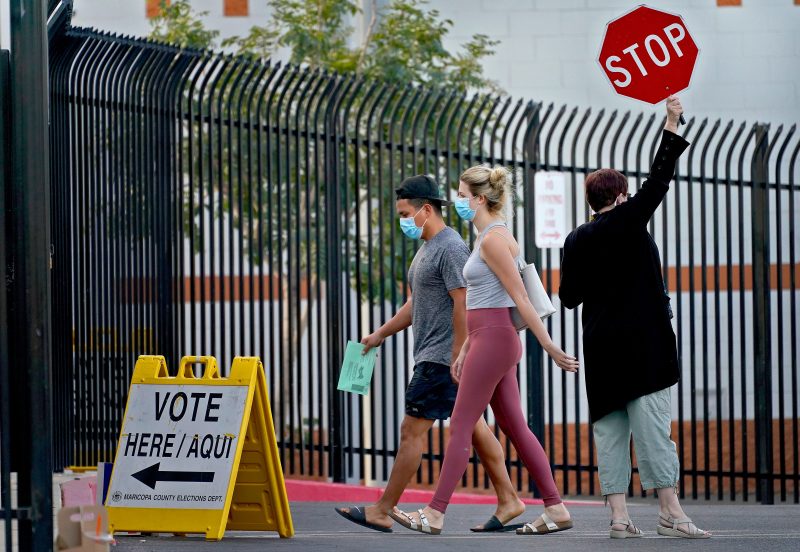
PHOENIX — For the first time in as long as anyone can remember, Arizonaâ€
The reasons have been building for years, but the final straw for Mesa Public Schools officials came last November with a small, low-turnout election that became mired in misinformation and menace.
“It was very chaotic,� Assistant Superintendent Scott Thompson recalled. “It was overwhelming.�
Although voting was supposed to be done mostly by mail, mistrust led many voters to drive to the schools to fill out their ballots in person, causing traffic jams and confrontations. Voters confused school staff for election workers and harangued them. Some accused school staff of “disenfranchising voters� for hosting secure ballot drop boxes.
“I couldnâ€
For generations, public school gymnasiums, classrooms and cafeterias have been fundamental to American elections. But when voters in Maricopa County — home to Phoenix and more than half of this swing stateâ€
In the eight years since Donald Trump was first on the ballot, hundreds of schools throughout this fiercely contested battleground county are no longer willing to assume the risks associated with holding elections. In 2016, 37 percent of county polling locations were schools, according to a Washington Post analysis of data obtained through a public records request. So far this year, itâ€
Heightened school safety protocols and sustained attacks on voting systems and the people who run them — largely by Trump and his supporters — have prompted school leaders across America in both red and blue states to close their doors to the democratic process, according to interviews with nearly 20 school district leaders, county officials, school safety officials and election experts. In at least 33 states, the law says public buildings, including schools, can or should be made available as polling locations. In many districts, administrators now cancel classes on Election Day.
The challenge has been especially acute in Arizona, where Trumpâ€
Schools in the state can opt out of elections if principals say they donâ€
“In this environment, where you have people with body cameras and weapons that are being brandished, that is a concern — that is intimidating for many people,â€� said Scott Menzel, superintendent of the Scottsdale school district. “It just takes one flash point to ignite something thatâ€
The trendline endangers the very voting method that Trump and many of his supporters have spent the past four years demanding: in-person voting.
The decline of school participation could confuse voters accustomed to stopping by familiar institutions to vote, experts said, adding an extra step to find a voting center that some people might be unwilling to take. Public schools are often core to the identities of communities big and small, and their proximity to voters and large spaces make them ideal to accommodate crowds and voting equipment.
Maricopa County has had to scramble to find replacements, often resorting to renting privately owned spaces, including those in shopping malls. Officials have budgeted nearly $1 million to lease voting locations this year, up from $53,000 in 2016.
“We cannot provide an in-person voting model without the support of our community,â€� said Scott Jarrett, a county elections director. “Thatâ€
Location scouts for democracy
Maricopa County has a three-person team in charge of finding polling sites. They have grown accustomed to hearing the refrain: “Sorry.�
Late last year, they began planning for this yearâ€
The team examines records from the county assessorâ€
The team sizes up everything from building space to parking lots and determines if they meet all sorts of requirements, such as accessibility for those with disabilities. They email and call schools, town halls, commercial building managers and others who previously opened their doors or may consider doing so for the first time.
Ahead of the elections in 2022, they emphasized their “desperate needâ€� of polling places, according to emails reviewed by The Post. This year theyâ€
Many declined, citing parking, insufficient space or no reason at all. Over the past four years, 159 locations stopped serving as sites — including 28 schools, according to The Postâ€
In 2016, schools made up 239 of the countyâ€
There has been no rebound, as election officials had hoped: For a July 30 primary, just 31 of 221 polling locations were expected to be schools, as of June 28. General election locations have not yet been finalized but will likely be similar.
“This is people making a cost-benefit analysis,� said Bill Gates, a Republican county supervisor. “The costs are perceived as being greater because it could create issues or bring threats of violence — or even violence. And by hosting a vote center, could they be pulled into a conspiracy? Is it worth it?�
Curtis Finch, a superintendent from a school district north of downtown Phoenix, said he considered hosting a polling site.
“Heck no,� he instinctively thought to himself. “Have you been reading the newspapers lately?�
In 2022, he had to tell a man who showed up with a firearm in this open-carry state that weapons were not allowed on school property, he recalled. And he said belligerent voters yelled at his staff over lines.
“In the old days, it was fun, and people were all excited to come vote — red, blue, green, didnâ€
After weeks of negotiating, Finch agreed to allow a district office to be used as a polling site — only because children can be easily separated from voters, he said. He also offered up a bus parking garage.
“I have been trying to be a good neighbor,� he said.
High state of ‘uncertainty and anxietyâ€
Over the past two decades, amid school shootings and heightened safety protocols, many schools across the country began bowing out of participating in elections. The covid-19 pandemic in 2020 accelerated the pullback, as administrators worried about the spread of the deadly virus. And amid deepening Republican distrust of institutions and elections, it has been difficult to recruit those schools back, according to school and election officials, and a national report that examined where people vote.
“Weâ€
Schools that are able to move polling away from their campuses have done so, but many cannot, often because of state laws requiring that they serve as voting sites if asked. Those school districts have increasingly held staff-only training days on Election Day, he said.
“The schools that have gotten rid of it are happy that they did, and theyâ€
In some counties, the number schools that are hosting polling locations has gone up.
In Floridaâ€
“Itâ€
In New Jersey, Union County election board administrator Nicole DiRado is also relying more heavily on schools, which can lose state funding if they refuse to host polling places. The overwhelming majority of the countyâ€
“Look, I get it — I have two kids in public school,� DiRado said. Before she learned their school would be closed, she added, “I thought about keeping them home this year on Election Day.�
Push for civic participation
For all the challenges in Maricopa County, there have been wins.
Over the past four years, 109 new polling locations have emerged, including 15 school-affiliated ones and a large viewing room at a mortuary — although itâ€
The newly opened Mountain Park Health Center in a city west of Phoenix was designed to ensure that its community room and parking lot are large enough to accommodate voters. Though that clinic will not be a polling site this year because of election-calendar deadlines, two of its other locations will be.
“People feel healthy and stronger when theyâ€
And churches make up a higher proportion of polling places, a trend largely driven by the Church of Jesus Christ of Latter-day Saints, which emphasizes civic participation. The church planned to provide 27 buildings for this yearâ€
“It really comes down to: we cherish the opportunity to live in a country where we have the privilege to vote,â€� said Candice Copple, the LDS Churchâ€
Morse and Natanson reported from Washington.